

Toward a Meaningful Life with Simon Jacobson
Radio Show Transcript – April 23, 2000
Rabbi Simon Jacobson: I want to wish all our listeners a happy Passover, the festival of freedom and liberation. I wish us all the power and ability in this window of opportunity to access our own inner souls, which provides the strength to liberate ourselves. When you become enslaved by the material oppression of life—the need for instant gratification and the other forces that hold us hostage—the only respite and true freedom is when we access our inner souls.
I want to thank those of you who called in last week for participating in a very productive show. The calls were very different, but they showed that both in little and big ways, we face questions that affect our sense of freedom and that even at a most personal level, freedom and truth are intimately connected.
Last week I discussed the general approach to emotions. Clearly, emotions are a very powerful and positive force in our lives. It’s what makes life life. Experience, passion, the driving forces and ups and downs of our lives are what make life so beautiful and important.
At the same time, emotions have the emotional trap of almost obsessive subjectivity, where we become blinded, and I cited the verse that bias and subjectivity “can blind the eyes of the wise and distort the tongue of the tzaddik (a great righteous person).” What I addressed primarily last week were two things: The first point was that knowledge is freedom; that it’s key to open up our minds to wider and broader perspectives if one is to ever find some type of emotional freedom. If not, we become locked in our own patterns, in a rut, in habits that we usually pick up from childhood and on.
The second point was that in order to access that type of objectivity without compromising the emotional tapestry of our lives, it’s also important to have a mentor, an objective friend, someone who’s sensitive whom you can honestly share your thoughts and feelings with, someone you trust, because he or she can be a sounding board that helps you see yourself in a different light.
In this same spirit of the season of freedom and liberation, I’d like to address tonight how one actually looks and examines one’s emotions, because the issue here is not to become an objective person entirely. We’re not trying to become computers here. A brain is a beautiful and powerful thing, but the brain without a heart, without an emotional life, is frankly not only dry, it’s dead.
One of the Chassidic Rebbes once said that there is nothing as cold and as dead as a mind. So a mind is a good analyzer, a good analytical tool that processes information, but there’s an analogy about the mind and the heart that says the mind is like the captain of the ship, but the ship that goes through the ocean is your emotions.
What is it to be a captain if you can’t travel? Emotions are the travel and the journey we’re on. But the captain of the ship needs to be there to help us navigate and see our way to focus, to direct, to channel our emotional experiences.
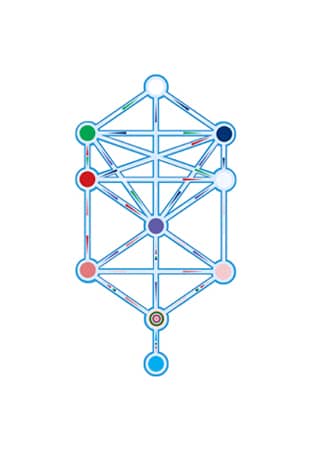
So tonight I’d like to discuss particular emotions, the spectrum of emotional experiences that we have. It’s interesting that in the Kabbalah, Jewish mysticism, there is a map of the emotions. It’s a map that divides the emotions into seven categories, seven particular attributes and faculties. We have many emotions but they become one big jumble if we do not distinguish between one emotion and the next.
The reason I’m doing this this week is that we are in the Festival of Freedom, Passover, and in Jewish tradition there is a custom, a mitzvah actually, that’s called the “Counting of the Omer.” The Counting of the Omer is a custom that was done when the Jews left Egypt. Following the Exodus from Egypt during this period of time 3,312 years ago, they counted the days in anticipation of receiving the mandate, the Torah that they would receive 50 days later.
They counted 49 days. The Counting of the Omer is a commandment in the Torah: Following a special offering that was brought to the Holy Temple every year, on the second day of Passover, the verse in Leviticus says, “You shall count from the day that you brought the omer as a wave offering,” which was brought on the second day of Passover. Following that they counted for 49 days.
Now the number 49 is significant because it’s seven times seven. Seven weeks with seven days in each week. As we all know, 7 x 7=49. Each week corresponds to one particular emotional attribute. So these 49 days were perhaps the original 49-Step Program before the Step Programs were instituted in our generation. They were a refinement process that the people then used as a stepping stone to analyze and inspect and review their emotional lives.
To do so effectively, particularly when you’re dealing with subjectivity, requires a meticulous approach where you take each emotion, look at it, and examine it. They did this for seven weeks. Each week was dedicated to one of these seven emotions, and within each of these seven emotions, each one breaks down further into another seven (another 7 x 7=49).
I created a little workbook called, The Spiritual Guide to the Counting of the Omer, which describes exactly what goes on during these 49 days, and how to use it in a personal way. I’ll give more information on how to get it later on. The book outlines the 49 steps with an exercise for each day.
What we’re going to do now is map out the emotional spectrum of our lives. This may be the first time some of you actually hear a map of what your emotions look like. Remember, you can’t look in the mirror to see your emotions. You can’t go to a doctor. Your emotions are invisible. So what do our emotions look like? Are they white, or blue, or black, or are they tall or short? How do we define our emotions? Here is a map that defines our emotions in seven different categories.
Before we begin, let’s go to Louise on the air.
Caller: A good holiday to you. I have two questions. First, the Ashkenazim and the Sephardim seem to have different requirements and prohibitions about foods to be eaten during Passover and I wondered how that comes about. Correct me if I’m wrong, I think that Sephardim are permitted to eat things like rice and peas and Ashkenazim are not. I’m puzzled. If these are holy requirements, Biblical requirements, why do they differ from one group to the other? That’s my first question.
Jacobson: Thank you for your question. I’m trying to discuss a particular topic, so I hope you don’t mind Louise if I’m brief and try to connect it in some way to the topic of emotions.
Louise’s question, for those of you who may not fully follow, is that on Passover there’s a prohibition against eating anything leavened, bread and bread products, actually anything made of grain or barley or oats, and so on. There’s also an additional custom followed by the Ashkenazim (people who came essentially from central Europe) that they also don’t eat what’s called kitniyus. Kitniyus means things that come from certain bean families, including rice and peas—things similar to the grains. That’s why, at a certain point in history, they decided to include these foods in the prohibition, in order not to create confusion. There was a problem with people confusing kitniyus with grains, and so in order to avoid that problem, they also prohibited that.
In Sephardic countries (Sephardim are Jews who came either from Spain or the countries controlled by the Moors, and the Arab countries including Yemen, Saudi Arabia, Egypt, and so on), as it is with other customs, that was not an issue. Either it was not an issue because people never confused the two, or because beans didn’t grow there, or whatever it was, so the Sephardim never accepted upon themselves that prohibition. The diversity within Judaism is quite beautiful—you can have two different groups, depending on where they lived, and even though Judaism does have its absolute prohibitions, there are areas where there is room for diversity. That’s my brief answer to you. But thank you for the call.
How to connect beans with emotions I don’t know, but let’s go back to my topic about the seven emotional attributes.
Jewish mysticism, the Kaballah, discusses the human psyche, by explaining that a human being is more than just a body. We have a spirit, and each of us has a unique personality. Yet there are common denominators, which connect us all, and the first common denominator is that our conscious experience (we’re not discussing the subconscious here) divides into two: the intellect and the emotions. The intellect is the mind, and the emotions are our emotional impulsive experiences.
The emotion that always comes to mind when someone says “emotional experiences” is love, and of course its antithesis, which is hate. Those are emotional experiences. But the fact is, besides love there are six other emotions that comprise our human experience according to Kaballah.
I’ll spell them out for you in Hebrew and then translate them into English. The first of the seven is love, chessed, in Hebrew. Chessed is lovingkindness, benevolence—anything that’s included within the family of love, and the warmth and nurturing that comes with love. It’s a feeling in our hearts. It’s our first and most fundamental emotion.
The second is the alter-ego to love, which is gevurah, and that is justice, discipline, restraint, awe. If love is giving and flowing, there’s another emotion which is withdrawing, focusing, disciplining, channeling.
Emotion number three is tiferet. Tiferet is translated as beauty, harmony and compassion. It’s somewhat of a synthesis of the first two, but it’s beyond that: tiferet has its own power, the power of compassion that goes far beyond love. You can have love for those who are close to you, those whom you appreciate. Compassion is for strangers and people who may not deserve it: mercy, or in Hebrew and Yiddish, rachmanut.
Emotion number four is netzach. Netzach literally means victory, but the emotion involved is endurance, fortitude, ambition. Netzach is the driving force behind every ambition.
Emotion number five is hod, and that translates into humility, splendor, and the emotion of humility, yielding. If the alter-ego of gevurah is chessed, where chessed is a flowing love and gevurah is the channeling, the measuring of it, then if netzach is ambition and drive and fortitude, hod is humility and yielding that balances the ambitions within us.
Yesod is number six. Yesod literally means foundation but it’s an emotion called bonding. When you bond with something it’s not just that you’re experiencing it, you actually bond with it.
And finally number seven is called Malchut. Literally it means nobility and kingship, but on the emotional spectrum, it’s sovereignty, leadership, the independence of a human being, the feeling that we are sovereign, that we have something to contribute, something unique about us.
These are the seven emotions as outlined in the Kabbalah. I’m sure there are parallels in other systems, however the Kabbalistic system is very comprehensive, and I’d like to elaborate on these. The period of time we’re in right now is really a time of examination. For instance, now we’re in Week One, which is the week of love. We look at how we love. Now the value of this examination is such that it allows us to step back and be somewhat objective about it. Now we can’t be entirely objective about our feelings, but we can examine them. There are ways of asking yourself certain questions that can help you look at these different dimensions within yourself and see: Are they tempered? Do we experience them to excess? Are we lacking in a certain area? Is there another area that requires balance?
Examining it is the first step to emotional freedom because you’re beginning to look at something with emotional objectivity.
So after spelling out the seven emotions, let me give you a few examples to show you how powerful the system is in helping a person become emotionally health and grow in the areas of personal growth and personal self-actualization.
If you asked many people the question, “Do you grow emotionally?” many of us would say that we grow intellectually. We grow perhaps financially and in other ways. But the cliché is that once you’ve matured, there’s no more room for emotional growth. What you have is what you have. Who you are is who you are.
But the truth is that’s not the case. Because of its subjective nature, it’s more difficult to grow in the emotional realm than the intellectual realm because the emotions are not about knowledge. Everyone can understand knowledge—the more you read the more you study the more you learn. There are subjects you may be completely unfamiliar with, but with emotions it doesn’t seem like there’s anywhere to go. Once you’ve developed a certain emotional approach to things, is there a place to grow? And the answer is definitely, because the emotions are a reservoir of resources within us: by looking at an emotion you can begin to see, “Can I become a more loving person? Do I love too much?”
And that brings me to an example of how one examines one’s emotions. I’ll use love, the one that we’re focusing on in this period of time, in this 49-Step Program.
Love is an emotion that we all need. We need to receive love and we need to give love. One can even say it is the most powerful and the most necessary component in life, the foundation of all human interaction. It is both giving and receiving, and allows us to reach beyond ourselves. In one word, it’s a form of transcendence.
Now, when we love, whether it’s our family, friends, spouses, or whomever it is that we love, love is not just a simple matter. We see that in the name of love people have been hurt as well. I remember going to speak somewhere and the host asked me, “What are the top ten favorite topics that people like to hear about?”
And in my experience, traveling and communicating to different audiences, I said, “Topic number one is always love, relationships, sexuality. The second favorite topic is pain and suffering.”
So he said to me, “Those aren’t two different topics; there the same thing.”
He obviously saw love and pain and suffering as two sides of the same coin, which is often the case. You often find many people who are afraid to love because they are afraid of being hurt. Many of us have gotten hurt from love, we saw what kind of damage could be done in the name of love, and we don’t want to be vulnerable again, so we protect ourselves.
So love is a very nice emotion and we all aspire to have a very healthy love, but love also has another side to it which is when you love, you can be hurt. Examining love is extremely important because in a way, I would say, love is perhaps the single most important ingredient in our lives, and the single most important source of misery in our lives, particularly when we can’t find the love we need or we’re lonely, or we’re hurt, or we’re hurt by our parents who presumably loved us—or they did love us and didn’t know how to love.
And what about ourselves when we turn to people around us and we don’t know how to love? Or we don’t know how much to give, how much not to give.
So examining this emotion called love is not just a simple matter, like, I want to know whether I love well or I don’t love well. It requires looking into details. That’s why the seven steps, the seven weeks break further into seven subcategories. Within love itself there are all seven which I mentioned. So love has the love within love, the discipline within love, the compassion and beauty within love, the endurance within love, the humility and yielding in love, the bonding in love, and finally the sovereignty in love. For love to be effective it requires looking at all seven elements.
In other words, when you love, there are certain things that are necessary. The first thing of course is do you love well? Do you have the capacity to love another person? Do you have problems with giving? Are you stingy or selfish? Is it difficult to let someone else into your life? Do you have room for someone else? Are you afraid of being hurt by vulnerability?
These are questions that are addressed in the first step of looking at the way we love. If the answer to any of those questions is yes, I have that type of difficulty, then you have to look at why. Why would people have difficulty loving another? Is it because they’ve been hurt? Is it because they may be so self-contained and think no one understands them?
That’s the first thing that you need to examine. As I mentioned earlier, to examine our emotions also requires, first, looking into a book that may discuss this in some objective light, and second, talking to someone who can be objective and in some way help us see ourselves in a different light.
Then there’s the other side of love. Let’s say you are loving. Are you loving too much? That’s where you need the second dimension, which is called gevurah, discipline. We see that parents who love their children too much can also harm them, because they may spoil them. The children begin to expect everything; they begin to have an exaggerated sense of entitlement. So we see that love requires measure, discipline and channeling.
Look at raindrops. Rain is a benevolent gift from heaven that allows things to grow. But if the rain came down in buckets it would flood the field and then nothing would grow. So a rain’s beauty is that it comes down in raindrops.
In Kabbalistic or psychological terminology, that’s called gevurah she’be’chessed: that within love you need gevurah, the discipline and channeling. If you look at the way you love, you will often see that one of these two is usually exaggerated. You may be loving too much without enough discipline, or you may have too much discipline and not be loving enough. It is a dance that requires a certain synthesis, a balance of knowing when to give and when to stop, when to allow it to flow and when to withdraw, without in any way undermining one or the other.
Those are two examples of how one looks at the emotions, particularly in this area called love. But the same is true with all the emotions that I described. Love also needs compassion and beauty. It’s not just that you love, but that the love comes with a certain balance, a certain synchronicity. And love needs endurance. There are many people who are very loving but the love doesn’t endure. It’s for the moment. They’re good at short-term relationships. They’re good if there’s a crisis. But endurance, to go through the difficult times, to have the consistency that’s required, is another element of love. So some people love very well but it doesn’t endure, it doesn’t stay too long. They get bored or something else comes up.
Love requires humility. Often love is a very selfish act. You love someone because you get something from the person and so you’re ready to give. So you have to look at your yielding ability. I’ve seen parents who love their children so much that you can say basically they love them to death. I don’t want to say the word “death,” but they can love them so much that they don’t have any yielding, they don’t allow the child to have its own independent personality and choices to make which can be very unhealthy. You need to have the ability to look at your own love and say, “Maybe I don’t have it all right.”
In the name of love, parents say, “My child has to do so and so because I love her so much, I know better.” That may not be healthy. So love needs yielding. It needs to be able to yield and be humble in the way we love.
Finally, there’s bonding in love—not just to love someone but to actually bond with them so there’s a deep connection. You spend time and you share a common vision.
And then there’s sovereignty in love. Love promotes and advances human dignity as opposed to being demoralizing. It helps us be better people. If your love causes someone else to be demoralized, there’s a problem with that love.
So this is a crash course for a one-week emotional exercise which, I must admit, can’t take ten minutes the way I just described it. It requires seven days of the week. To go through each one of these items is really a seven-step process.
The first day of the 49 days would be the love within love. The second day we concentrate on the discipline within love.
As I mentioned, I created a book called The Spiritual Guide to the Counting of the Omer, which has gotten a very positive reaction and I invite you to check into it. You can contact my office at the Meaningful Life Center to obtain this book. You can call us at 1-800-363-2646 (1-800-3MEANING) or email us at wisdomreb@aol.com, or write us at The Meaningful Life Center, Suite 303, 788 Eastern Parkway, Brooklyn, NY 11213. And finally, you can visit our website at www.meaningfullife.com.
Now, when we talk about emotions, the first thing that comes to mind for me are my own personal experiences, my own subjectivity. Each of us is subjective in our own way. As I mentioned last week, if you think you’re objective, that’s part of being subjective: it makes you think you’re objective.
When you look into your own experiences, the fact is, as much we can discuss them, emotions have a hold on us that don’t allow us to see outside—like being in a box where you just see it your way. The thing that’s so exciting about life—of meeting people and being able to communicate with them—is that even though each of has our own personal pride and our own personal investment in our choices, if you can find someone whom you can have an intelligent interaction with, and they can stimulate and challenge you without undermining you, it really brings out more objectivity than we could ever allow on our own.
One of the beautiful things about the Seder table, which is the Passover tradition on the first two nights of Passover, is that one of the big emphases is on questions, encouraging children to ask questions, inviting them to ask.
If you think about it, the questions in the Haggadah are much more pronounced and much more tangible and identified than the answers. You have to really search for the answers to some of those questions that are asked. This is true with the “Four Questions” that the children ask at the table, or just in general: many things are done during that evening in order to provoke questions.
It struck me that on a very simple note, one of the greatest celebrations of freedom is the ability to ask. Just the ability to ask. Forget about the answer. The power of being entitled and empowered and given the permission to ask a question, to challenge, to be skeptical in a healthy way, curious, is a real freedom, a real freedom of knowledge.
You’ll always find silence in Fascist regimes. People are silent. You cannot demonstrate. Free expression is not allowed, and so on and so forth. That ability, which is celebrated on Passover, is the ability to ask a question, “Sha’al avicha v’yageidcha,” “Ask your father/parent and he or she will tell you.”
The ability to ask the “Four Questions,” is in itself freedom. There’s a statement from the holy Sages that says, “The question of a wise person is half an answer.” That doesn’t mean that within the question lies the answer, it means that the way you formulate a question—it may take sometimes a lifetime to find out what your question is—when you know your question, you’re already halfway there.
So the ability to ask questions is a freedom that is perhaps the greatest first step in any freedom—the ability to ask and therefore to search for answers. That’s what struck me on a personal note.
When we deal with emotions—especially in the area of abuse, they say—the silence is worse than the abuse. The cover-up is worse than the crime, because it’s the silencing, the invalidation, the undermining, the shrouded secrecy of any problem in our family life or in our personal lives. That in itself is the greatest enslavement.
Knowing that you have an illness is half the cure. That being said, when we look at our way of dealing with our emotions, our feelings, and so on, that ability to ask questions, to allow yourself to ask questions, to be engaged, is the first step to any type of freedom. That’s why even though we may not have full answers to these questions: “Do you love properly? Do you love with too much or too little love?” by asking that you begin to challenge yourself in a healthy way and you say, “Maybe I need to look at that. Maybe I need someone to help me look at that.”
We’ll go to Benita on the air.
Caller: Hi. This was very appropriate today. A few days ago I was shopping for Passover and I threw my back out. I had attended the first Seder and the second night Seder, and it was a wonderful experience, I had a wonderful time. I got up from the second night Seder and I couldn’t move.
To make a long story short, I wound up calling 911 and ended up in the hospital with my back thrown out. I had to go through tests and basically there’s nothing wrong except muscle spasms. I understand that it’s all emotional. I just wondered what you think about the connection between the emotions and physical pain? I’m still suffering here and I understand that there’s nothing they can do except give me muscle relaxes.
Jacobson: First of all, I want to ask you about your own state right now. What provoked that? Are you going through some anxiety in your life now?
Caller: I don’t think so, but I think that probably I’m just normally a very tense person and basically I react in a way where my muscles must constrict or tense up for me to experience this pain. Everybody was very helpful at the Seder—trying to tell me to go to chiropractors and see a bunch of doctors, and that just made it worse.
Jacobson: I understand. Do you have family? People who love you, whom you love?
Caller: Yes, very much.
Jacobson: I don’t mean to give you a full interview here, but I just want to know where you’re at. Do you have children?
Caller: Yes I do. And everything is both a source of joy and a source of stress in my life. I can’t really separate a lot of it. I have a lot of joy and also a lot of stress.
Jacobson: I understand that if you are sitting around the Seder table and people start giving you their chiropractor’s names, it is not exactly a source of solace.
Caller: Well I ended up in the hospital…there was a Jewish doctor there who sympathized with me.
Jacobson: So answering your question, there’s no question in my mind that emotions have a direct impact on our bodies. First of all, the spirit and body are like two partners in one’s life. It’s been proven that the body carries messages. With people who have suffered from PTSD, Post Traumatic Stress Disorder, a trauma at young age or in war or so on, their bodies clearly remember that. Even if the mind forgets, the body does not forget, and a lot of tension, the knots that tie us up, are often the result of implosion, which means it implodes instead of explodes. Instead of an outburst, especially if you’re silenced, your body begins to tense up under certain situations.
This is a normal reaction, for instance, if you’re in the street and there’s something that causes you to panic, the body becomes tense. So emotions clearly have an impact on our body and can cause back pain, headaches, and other pains.
The appreciation of the balance of these two forces, the psychosomatic effects of emotional trauma or emotional experiences, is being discovered more and more in medicine today. But you should be aware that it also works the other way around. Joy and pleasant things in our lives also have a physical impact on our lives.
As a matter of fact, the Talmud says something that was always ridiculed by skeptics, and now they see the wisdom of it. The Talmud says that there was a man, Aspasyanus who was a Roman emperor, and when he heard the news that he became the new emperor, because of his joy, he couldn’t fit his shoe on his foot. His actual body expanded somewhat because of the joy and celebration in his heart.
So you have to remember, Benita, that it also works the other way around. Bringing love and joy into our lives can untie knots. I don’t know the particulars in your own personal life so it’s hard to make a suggestion without knowing them, but I would say that it’s important to recognize your own emotional reactions, it’s very appropriate that you look at your own emotional spectrum in your life. I would highly recommend obtaining my workbook—and if you stay on the line I could put you in touch with people here at the station who can take your number. I think it would be good to go through this workbook because it’s very helpful. More importantly, I want you to give me information if you do explore your emotions, because I think it could help others as well. We’re trying to create some breakthroughs here, of finding methods that emotionally can nurture us and that have a direct, positive impact on our lives.
I think it’s important that you spend positive time with people who love you, and if there are any stressful situations that you can get away from, that’s very vital at a time when you feel this way. In addition, I extend to you my blessings for a happy holiday, but more importantly, a holiday that frees your body.
Look at it this way. It’s a wake-up call. Maybe your body is telling you that there’s something you need to look at. Like pain. People don’t like pain. But pain warns us that there’s something coming. So it could be that your body’s telling you that there’s something to look at here.
Caller: Do you think that it’s possible that when you feel stress, to take your mind off the stress and dwell more on the joyful part of your life? It’s very hard for me when I’m in a stressful situation to not be overwhelmed by the stress and the tension.
Jacobson: Well, if you’re able to do that, to take your mind off it and read a book or have a conversation with someone who really stimulates you or loves you, that’s great. Obviously, any type of medication that can help relax you, like muscle relaxants, are definitely useful—not to the point of over dependence—but to create some clearing, some space in which to pursue positive things.
I gather from your sharing this with me that this is new to you, that it hasn’t happened in the past.
Caller: It’s happened a little bit, but not to this extent. I’ve always been okay within 24 hours. It’s never been this bad where I had to go to the hospital. I basically was in such excruciating pain that I couldn’t move.
Jacobson: Did you have any of the bitter herbs on the Seder table?!
Caller: I did! And the first night I was fine because I was really relaxed. I was reclining as I was supposed to!
Jacobson: Well listen. Not to justify it, but perhaps you experienced some type of true freedom that’s opened up a new channel and created this new pain that’s only a momentary thing and I wish you the best to get beyond it. Thanks for your call.
We have Shifra on the line.
Caller: Yes Rabbi. I have your book in my hand, The Spiritual Guide to the Counting of the Omer, and I would like to say to the entire audience, I gave it as a Pesach gift to four families. The children are beginning to use it, and someone said you can use it all year round, that it’s not just something for this time of the year. It’s an experience of introspection, of learning so much about yourself, of going inside. Last year I used it and this year I’m going deeper and deeper, as though it’s an unending well.
The second thing that I would like to share, is that there are two expressions, active and pro-active, which means for me that one reacts immediately in most situations in contrast to becoming pro-active.
How can one transform, going from a reactive person to a pro-active person?
Jacobson: The first thing is to take charge of your life. Control in life comes through action. To be pro-active means to be active. To take control requires making a move. I believe that every one of us has human dignity, the divine image in which we were created, empowers us with the ability to make a move.
That move may be getting out of a situation that’s unhealthy, meeting a new friend, going to a new class, reading a new book, whatever it takes. It’s the emotions that trap us. As I stated earlier, it’s like a rut. People don’t have LP’s (long-playing record) anymore, except for collector’s items, but in the olden days there was a thing called a scratch in your record. A scratch in the record meant that the music would start playing again and again and again. Like a groove where you just go around like a merry-go-round.
The “scratch in the record” means that even though LP’s don’t exist anymore, we still have our emotional scratches, meaning, we go around in patterns again and again and again. I hear people tell me, “I can’t believe it. I was in an unhealthy situation, I finally got out of it, and five months later I’m back into the same situation. What is this?”
But that’s the nature of the beast—the emotional beast. The emotional tentacles of the landscape called our experiences. To get out of that it’s critical that we make a move. I think that’s how a person becomes pro-active. It’s as simple as making a move. If you have a friend who’s unable to make a move, it’s important that you try to reach that person and say to them, “Let me invite you somewhere.”
Now some people are in a state of despair where it’s so dark for them that there’s no way out. What to do in that situation sometimes requires patience, sometimes you need to nudge them, and sometimes you need to kick them in the pants, it really depends on who they are and what kind of relationship you have with them. But making a move is the key.
Talking about love and emotions really means examining your life. I don’t want to use a cliché, but there is a well-known philosopher who said, “An unexamined life is not worth living.” Coming from a Torah perspective, that is essentially the whole theme of Torah thought. It’s looking at yourself and looking at your relationship with G-d.
When Adam hides from G-d in shame after eating from the Tree of Knowledge, G-d says to him, “Where are you?” or using the biblical, “Where art thou?”
Now G-d knew where he was. No one can hide from G-d. Why would G-d ask, “Where are you?” G-d was saying, “I don’t recognize you—because you don’t recognize yourself. I don’t see you.”
You can be sitting near someone and the person spaces out. You see them physically but you don’t know where they are, where their mind is, what their focus is. The key is to examine your life. Where are you headed? What are your objectives? What is your personal mission statement? Practical things that force you to take a look at yourself and not just go through the motions.
Thoreau writes, “Most people live a life of quiet desperation.” Are we ready to just resign ourselves to just being an observer in life? To do damage control? To do the least and play it safe?
Life is life. The key is to be able to look at life and embrace it. To celebrate it. You wake up in the morning and say, “I’m really excited about this life. I’m not looking over my shoulder all the time wondering who’s going to hit me next, or where the next curve ball will come from.”
I think that’s called pro-active. But it’s not good to criticize people who aren’t pro-active. Often it’s the result of fear, which is another emotion, an unhealthy emotion, that paralyzes us and doesn’t allow us to look at ourselves.
So that’s my answer to Shifra’s question but also the general theme of this show.
Now emotions aren’t exactly fun because they can be quite wrenching and quite powerful, as we all know times that our emotional lives can be a wreck. You rarely hear someone say, “My emotional life is just great.” Because emotions by nature are complex. They can be ambiguous, paradoxical. You can love and also be in pain at the same time. It’s such a jumble.
However, by looking at the way we love, and the other emotions that I mentioned on the show—love, discipline, compassion, endurance, humility, bonding and sovereignty—looking at them is the first step toward some type of clarity and freedom.
Is it magic? No. Nothing is magic in this life. But examination, review, analysis, allowing others to help us look at ourselves is the key way, the only way, to growth. I encourage all of you to look at your feelings this way. It’s not easy. It’s hard to look at yourself because you may be afraid to see something ugly. You may be afraid that you can’t change, so what’s the point of looking at it? You may be so consumed with other things going on in your life, that you don’t have time, as people say, “I’ll make time when I retire.”
But the truth is, we really have to be true to ourselves and have integrity and honesty when we examine ourselves. Ultimately only you can determine whether you’re ready to examine your own emotional life.
We have Norman on the air.
Caller: I’d like to emphasize that you as a member of the clergy, in fact most clergy, but you’re on a higher level, most clergy do not emphasize the power that the Torah and other works give us, that we are great, we are in the Divine image. That message which should be repeated often by the clergy is going to help people realize their potential. We have to realize and repeat it to ourselves. But the clergy repeating it and bringing out appropriate proverbs is very important. I would appreciate it if you would do it more. You’re really at a high level there.
Jacobson: Thank you Norman. I’ve never been identified as clergy but it’s a nice title. I hope it doesn’t intimidate anyone. But I appreciate your comment. We go to Lewis on the air.
Caller: Hello Rabbi, how are you? I don’t know if this question is appropriate, it’s more personal than general in nature, but for 20 years I’ve been in a particular business and although I’ve wanted to look to different horizons, I just haven’t had the fortitude to do so. However, in the past month I’ve had three major casualty losses which put me in the position that I’m going to be out of business and I have to look to do something else with my life. That’s awfully hard at 42, after doing the same thing for 20 years. I would just appreciate any light that you can shine on my particular predicament.
It is somewhat of an emotional quagmire because I just don’t know which way I’m going to run.
Jacobson: You mean, what to do with your time?
Caller: Yes, with my business career. My life.
Jacobson: Well, it’s hard to answer because I don’t know what kind of work you’re in. Are there other opportunities ahead of you or do you have to write your own script?
Caller: There are opportunities but I just don’t know where to look. I’m a smart man and I’m sure that I’ll get into something but I’ll have to go through some upheaval. And that upheaval—sometimes you’re on top and then sometimes you’re on the bottom.
Jacobson: Yes. It’s a wheel. Well, since you titled yourself as wise, I’d say to you as follows: It’s critical that you allow someone whom you trust to advise, to give suggestions. I don’t know what your spiritual life is like; I don’t know what your personal life is like.
Caller: I happen to be Catholic but I always respected the fact that the Judaic religion gets more involved with philosophy on a personal and a more practical basis, whereas my Roman Catholic religion, which I’m very active with, is more about your moral behavior rather than your practical outlook, if you know what I mean.
Jacobson: I definitely do and I appreciate your confidence. In the brief time we have here, if you don’t mind staying on the line, you can give your number to the person answering the calls here and I can talk to you some more about this, or you can email me at wisdomreb@gmail.com. This requires more than just a 30-second response.
Caller: That’s very nice of you. I’d be happy to stay on the phone.
Jacobson: I’d like to first of all thank the sponsors of this show. I’d like to thank Robert Klein, whose generous support has made more than one show possible. Thank you Robert, I hope you enjoyed your recent trip and may I wish you a happy and kosher Passover, one that will be meaningful and liberating. Let me also thank all of you who in many ways, big and small, have contributed to the many ongoing activities and projects of the Meaningful Life Center.
I invite you to participate, because shows like this can only happen through your help, to either sponsor a show or get more information on the Meaningful Life Center. In addition to making a donation, if there’s anything that I can help you with, whether it’s a question, whether it’s an answer and I’ll give you the question, please call us at 1-800-3MEANING (1-800-363-2646).
I also invite you to call to order a copy of my book, The Spiritual Guide to the Counting of the Omer, the Original 49-Step Program.
On a practical note I’d like to suggest practical exercises for each of us: to look at our emotions and examine them requires making a move. Making a move may mean reading a book, making a friend, attending a class, but it’s about getting out of the rut, getting out of your groove and doing something new.
I think in this season of freedom and liberation, it’s a perfect time to do so.
This has been Toward a Meaningful Life with Simon Jacobson. Thank you.
Watch an eMotion Picture to see your seven emotions in action.





This transcript helped me tremendously. thank you
I could parrot the words back… but never truly believe them. Kind of like memorizing it for the high school test. You are able to include the why to do it, as well as the what to do. Without the why, there was no power to the words. Thank you.
Thank you. My google search surprised me with this find. Truly amazing, thank you and I will be buying your book.
Thanks much for YOUR EXPLANATION. GOOD TO KNOW !!!!