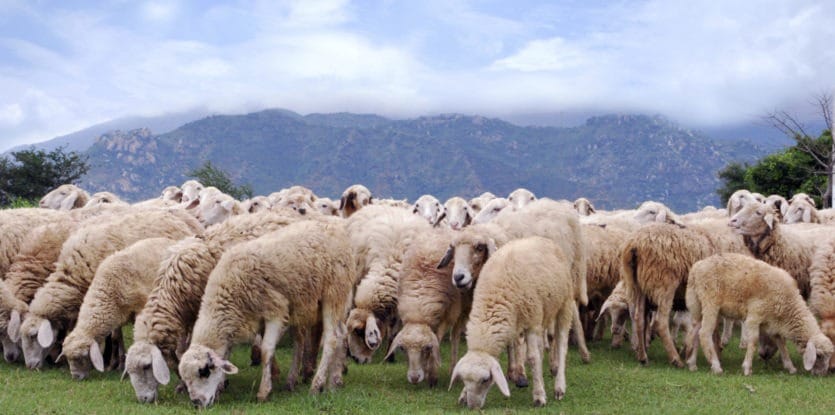
The Torah portion, Vayeitzei (Genesis 28:10–32:3), is veritably glutted with sheep: Laban’s sheep and Jacob’s sheep; white sheep, dark sheep, spotted sheep, speckled sheep, sheep with rings around their ankles. Jacob arrives in Charan, and the first sight to greet him is that of several flocks of sheep congregated around a sealed well; the second is his future wife, Rachel (the name is Hebrew for “sheep”), shepherding her father’s sheep. Soon Jacob is a shepherd himself, caring for sheep, receiving his wages in sheep, breeding sheep with special markings, dreaming of sheep, amassing a fortune in sheep, and finally leading his flocks back to the Holy Land where he will present his brother Esau with a huge gift comprised largely of… sheep.
Between flocks, we also read of Jacob’s marriages to Leah and Rachel and the birth of eleven of his twelve sons, progenitors of the twelve tribes of Israel. What are we to learn from the fact that the nation of Israel was founded in such sheepish surroundings?
The First Metaphor
“I am my beloved’s and my beloved is mine, he who shepherds [me] among the roses.”[1] The voice of this verse, explains the Midrash,[2] is that of the community of Israel, speaking of her relationship with G-d. “He is my shepherd, [as it is written,] ‘Shepherd of Israel, listen’[3]; and I am His sheep, [as it is written,] ‘And[4] you, My sheep, the sheep of My pasture.’”
The same Midrashic passage also describes our relationship with G-d as that of a child to his father, a sister to her brother, a bride to her groom, a vineyard to its watchman, among others. Each of these metaphors expresses another facet of the relationship: the inherent bond between G-d and Israel, the love and affection, G-d’s guardianship over us, our being a source of joy to Him, etc. What does the sheep/shepherd metaphor represent? If the point is that G-d provides for us and protects us, or that we are subservient and devoted to Him, these elements also exist in the father/child relationship. What unique aspect of our relationship with G-d can be expressed only by describing us as His sheep?
The sheep’s dominant trait is its docility and obedience. The child obeys his father, but does so out of an appreciation of his father’s greatness; the sheep does not obey for any reason—it is simply obedient by nature. It is this element of our relationship with G-d that the sheep represents: an unquestioning subservience which derives not from our understanding of His greatness and our feelings toward Him (in which case it would be defined by the limits of our understanding and feelings), but from the recognition that “I am His sheep.”
The Jewish nation was founded amidst sheep because our self-negation and unquestioning obedience to G-d is the foundation of our Jewishness. Of course, we are not only G-d’s sheep—we are also His children, His bride, His sister and His vineyard. By the same token, the Torah tells us that when Jacob left Charan after twenty years of shepherding, his wealth consisted not only of sheep: “He had much sheep, maids and servants, camels and donkeys.”[5] We have just read that Laban paid him his wages in sheep, and that his flocks multiplied exceedingly; but where did his other possessions come from? Rashi explains that “he sold his sheep for high prices and bought all these.”[6] Spiritually, too, Jacob’s “wealth” did not consist solely of docility and self-negation, but also included feeling and understanding, fortitude and vigor.[7] But the source and basis of it all were his “sheep.”
Being a Jew means studying the divine wisdom (revealed to us in His Torah), developing a passionate love and reverent awe for G-d, and teaching His wisdom and implementing His will in an oft-times hostile world—all of which require the optimal application of our mental, emotional and assertive powers. But the foundation of it all—the base from which all these derive and upon which they are all predicated—is our simple commitment to G-d, a commitment that transcends reason and emotion.
Based on an address by the Rebbe, Kislev 10, 5737 (December 2, 1976)[8]
[1]. Song of Songs 2:16.
[2]. Midrash Rabbah on verse.
[3]. Psalms 80:1.
[4]. Ezekiel 34:31 (see entire chapter).
[5]. Genesis 30:43.
[6]. Rashi on verse.
[7]. Indeed, in Jacob’s message to Esau, where he speaks of the wealth he had gained in Charan, he says, “I acquired an ox, a donkey, sheep, a servant and a maidservant” (Genesis 32:6). Unlike the previously-quoted verse, where “sheep” heads the list, here it is preceded by “ox” and “donkey.” At this point, Jacob was unsure of Esau’s intentions toward him (in fact, Esau was marching against him with four hundred men); so he wished to emphasize to Esau that while he is meek and servile in his relationship with G-d, he does not lack the vigor and fortitude to stand up against those who wish to destroy him.
[8]. Likkutei Sichot, vol. XV, pp. 252-258.