
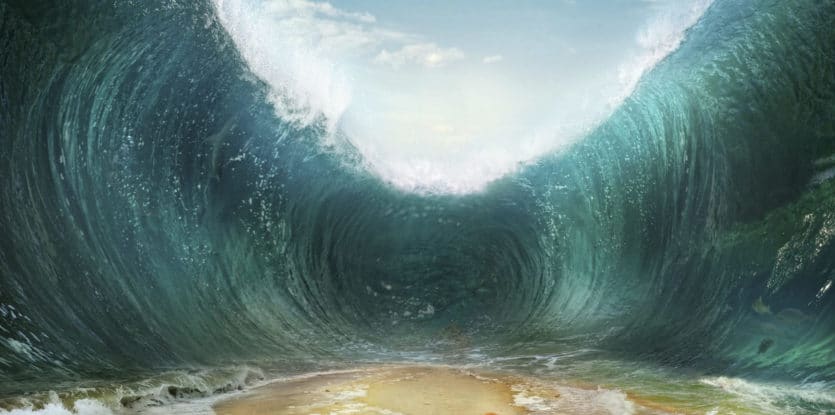
When Water and Land Collide
When a calamity strikes the public we must cry out, examine our lives and correct our ways. To say that the calamity is merely a natural phenomenon and a chance occurrence is insensitive and cruel – Maimonides, Laws of Fasting 1:2-3
When hundreds of thousands of lives are tragically and abruptly aborted due to a “natural” disaster, it must serve as a wake-up call to us all.
Even on a most basic level, it is nothing less than callous to be complacent if face of any catastrophe, especially one so sudden and so devastating, affecting so many lives, now and forever.
That’s why it is admirable to see the outpouring of international aid – from nations and from individuals – to the stricken countries. Obviously much more can and should be done to address the people in crisis. Yet, it is important to acknowledge every positive gesture of help.
Though hardly a consolation to the magnitude of today’s great tragedy, it is mildly comforting to witness nations having at least a semblance of awareness that we all are part of one human race, and we therefore share responsibility toward one another, something quite unprecedented in human history. You can’t help but wonder how countries behaved toward each other in centuries past when disaster struck their neighbors. Not only were nations oblivious of each other; they often were at war with one another, and natural calamities were simply exploited.
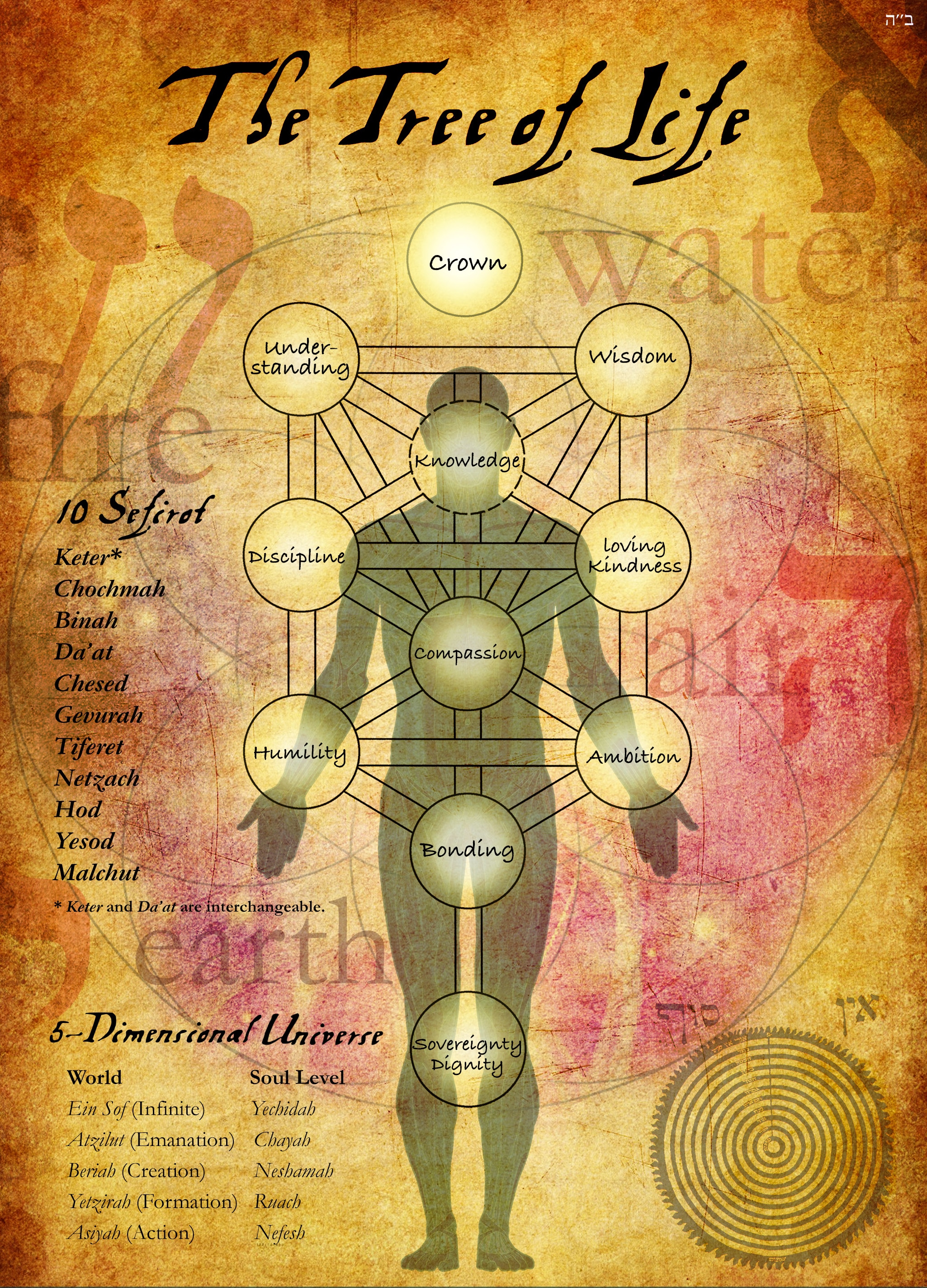
The mystics see our responsibility for each other in a cosmic way. All human beings – and for that matter, every fiber of existence – are part of one large organism; each an indispensable musical note in the Divine symphony. We are all integrally connected and interconnected. The loss and pain of one component affects us all. Indeed, all of time, space and spirit (man) are pieces of one seamless tapestry.
Yet, this integral web connection is hidden from our view. A great “shroud” conceals our interconnectivity and interdependence. The shroud is called the “grand tzimtzum” – a cosmic black hole that turns existence inside out, and allows us to think that we are alone and disconnected from everything else. It creates the narcissistic perception that the only thing that exists is you, in this moment and this space, with no inkling of your fundamental link with all other moments, spaces and people.
This “tzimtzum” is the startling root – both brilliant and horrific – of all human apathy, of every form of indifference and complacency that we are so capable of. Since we are all one cohesive organism, how is it possible, ask the mystical students of unity, that we should be able to go our way, sleep and otherwise disregard the suffering of our brethren?! Can one part of a body be at peace when another part is ailing?
Blindness is the answer. The great shroud masks our integral unity, and as a result we fell separate, to the point that we can actually harm each other, not recognizing that in doing so we harm ourselves as well.
Life’s great challenge – as great and even greater than the “tzimtzum” itself – is to wake up and be aware: To open the curtains and reveal the underlying unity through living an integrated life.
We cannot grasp the mystery of human suffering. Silence has always been the ultimate response to unfathomable tragedy. Not the silence of resignation. The silence of strength – of standing in overwhelmed awe of experiences that the human mind cannot contain. Not logic, not reason, not all of our other limited faculties can process the sheer senselessness of loss and grief.
Yet, men and women of deep faith always went a step further. They did not allow suffering to break them and their belief in the force of good. After silently acknowledging the mystery of pain, they forged ahead with fortitude and strength to become greater people and make the world a more beautiful place.
They understood that our integral unity infers another vital conclusion: Just as we are hurt when others are in pain, even thousands of miles away, we have the power to strengthen each other as well. In some strange way, our personal behavior in one corner of the globe has the power to repair ruptures in another part of the world.
* * * * * *
Yet, even as we intensify our commitment to goodness – and do everything in our power to help the less fortunate – the epic proportions of this tragedy overshadows all our kindness.
Lives have been lost, families shattered, millions traumatized. And above all, we have all been exposed to the sheer vulnerability of our lives on Earth. The earthquake and resulting tsunamis were not an act of man. They were an act of G-d. Some call it “nature,” but that simply is a name for the “program” that runs this universe.
Not to diminish human travesties, yet mans’ potential inhumanity to man is the tragic side-effect made possible by free will. This does not justify nor explain genocide initiated by humans. But at least we can state that the essential importance of free will and all its great benefits gives our existence purpose and meaning, and even if we don’t understand why, this benefit is worth the risk of people choosing to be destructive.
But in our case the catastrophe was an act of G-d. Not a human error or crime, but a result of the very fabric of “mother nature,” which produces earthquakes, volcanoes, tsunamis and other violent phenomena.
How can we possibly explain natural disasters in context of a good G-d?
True, once can say that earthquakes and tsunamis are not “disasters” per se; they are part of the “checks and balances” of the universe to maintain its balance. As, say, the tectonic plates that comprise the earth’s crust collide with each other, an inevitable earthquake relieves their tension and strain (like the spout on a kettle that allows for the release of steamed pressure). If there were no earthquakes to release the energy, the plates would ultimately destroy each other, causing far greater damage to the entire planet. Hundreds of small earthquakes therefore occur daily around the world.
If human were not living in the regions of these events, these natural “corrections” would silently keep the world intact with no trace of human casualty (as it is now with many of these forces occurring in mild forms, beneath the sea or in other places that do not impact humans directly). However, the fact is that humans have populated the universe (as commanded by G-d), and live in areas where they are vulnerable to the powerful forces of nature. We therefore must understand why are we exposed to these forces, and what possible reason can a good G-d want us to experience them from time to time, often with tragic results.
The question is amplified when it comes to the present disaster named “tsunami,” killer waves that destroy everything in their path as they strike land:
The Bible tells us that G-d decreed upon the sea that it should never cross over onto land. “This far you may come and no farther; here is where your proud waves halt” (Job 38:11).
He created a “line in the sand,” as it were, which serves as a boundary between water and land, never to be crossed.
“Do you not fear me? Says G-d: will you not tremble at My presence, which has placed the sand for the bound of the sea by a perpetual decree, that it cannot pass it: and though the waves toss themselves, yet can they not prevail; though they roar, yet can they not pass over it?” (Jeremiah 5:22).
How then can tsunamis cross over this seemingly impassable boundary? What happened to the decree that the “proud waves” go no farther that their own domain?!
The explanation requires a fuller understanding of water and land – the two global entities that Earth is comprised of.
In the beginning of time all of Earth was submerged in water. Then came a “divide between water and water,” separating the “waters above” from the “waters below” (Genesis 1:6), and the waters below were “gathered to one place,” allowing dry land to emerge, thus creating the distinction between “earth” and “sea” (1:9).
Ever since water and land have had a tenuous relationship, at times even at war with each other. On one hand land is in need of water for its sustenance. Yet, too much water can cause destruction. We are drawn to beaches and waterfronts, yet we fear the awesome power of the sea.
The mystics explain, that the material nature of the universe is but a manifestation of its spiritual personality. Water and land embody two forms of consciousness: Water is the unconscious, “hidden worlds,” and land is the conscious, “revealed worlds.” Water reflects utter unity, where all its creatures are submerged and always feel connected to their source. While land symbolizes fragmentation, with its creatures feeling separate from their source and from each other.
The universe began submerged in water to ingrain in its “psyche” its fundamental unity. But the purpose of creation is to separate the “upper” from the “lower” and “land” from “sea,” and that human initiative should reunite our seemingly “disconnected” world of “land” with its source and purpose.
When our work in doing so is complete, there will no longer be “evil and destruction” because the “universe will be filled with Divine knowledge as the waters cover the sea.” The evil and destruction that humans can perpetrate against each other is only possible when we do not feel our integral unity. But when we perceive that we are all like “fish in the sea,” submerged in and indistinguishable from our source (Divine knowledge), our interconnectivity will prevent any destruction.
Microcosm macrocosm. Each of us humans – mirroring the larger universe – begins life submerged in the watery womb. Nine months we spend there before we enter “dry land” upon birth. During this time our psyches develop a profound internal unity, which prepares us to face the existential loneliness of life on “land.” Then, upon birth, that “water” consciousness recedes into the background of our unconscious, and our conscious lives follow the psyche of “land mammals,” each of us self-contained in the here and now, living out our fragmented lives.
So the big question is this: Are we “water” people or “land” people? The answer is that in essence we are “water” people, integrally united with our source, but on our conscious level we have a “land” personality, with the purpose being that we discover the “water” within.
But here is the dilemma. Once land and water were separated, a primal and deep-seated tension separates them. The fragmented conscious universe becomes so consumed with its own immediate survival and self-gratification that it does not relate to the integral unity of “water consciousness.”
True, this division was initiated by the Creator who separated “land” from “water,” but the purpose of the separation was that we should emerge from the “womb” as independent entities, and transform the conscious world of “land” into a “world filled with Divine knowledge as the waters cover the sea.”
Indeed, the spiritual root of the separation between “earth” and “sea” is the tzimtzum itself. In order for us to exist as individuals we cannot be (at least consciously) submerged in the all encompassing “light-energy” of the Infinite. The divine decree therefore dictates that there be a boundary between “water” and “land.”
Yet, there are times when a door opens up between these two worlds. Sometimes it’s a healthy door, and sometimes it’s a devastating one.
This water/land dichotomy is a recurrent theme throughout the Bible. Take this week’s Torah portion. Moses is so named for he “was drawn from water.” The very water (River Nile) that could have caused the child Moses’ demise, as so many newborn males were tragically drowned in the River, becomes his savior. The very idol of Egypt comes to protect the one who would destroy this idol. Later Moses would part the sea, another manifestation of land/sea interaction.
The mystics explain that Moses was a “man of no words” because his soul originated from the “hidden worlds” of water, the intimate world of the unconscious, which is more profound and intense than any words of land can express. But for this exact reason Moses introduced unprecedented revelation to Earth. Precisely because Moses is a “water man” living on Earth, he is able to draw from the inner worlds, and bridge and express the language of the Divine and communicate it to the land people.
This only goes to show us how the two worlds of “land” and “sea” are so dichotomous, and we need Moses to help us bridge the two.
But even as they are bridged by Moses an inherent tension remains between “water” and “land.” A battle rages between them.
A tsunami is perhaps the strongest manifestation of this battle. What’s strange is that the force of a tsunami – a water surge that can travel up to 500 miles an hour – is not felt at sea. Ships in the open sea will barely notice the one or two foot waves generated by a tsunami. Its savage impact is experienced only as the tsunami strikes shore.
In other words water is not affected by water, no matter how powerful its force. Only land is affected, and… devastated.
Another fascinating fact is that a tsunami does not originate from water alone. Unlike wind-generated waves – the conventional sort that we are accustomed to – tsunamis are generated from the imbalance between… land and sea. Only a violent disturbance of the seabed – caused by an earthquake, landslides, volcanic eruption, explosion, or the impact of a meteorite – can generate tsunamis. When an impulsive disturbance vertically displaces the water column, it pushes a huge bulge of water to the surface, which results in a tsunami racing toward the shore.
A possible cosmic parallel to a tsunami is the Kabbalistic “breakage of the vessels” caused by the tension created between the imbalance of too much energy (“water”) and too little containers (“land”). This break (”shevirat ha’keilim”) is devastating; it releases chaos (“tohu”), hurtling “sparks” in all directions, embedding them in the deepest recesses of our material world.
However, the breakage is a necessary step in helping realign a misaligned universe. By exploding it releases the tension created by the tzimtzum between the energy and the containers – the dichotomy of the two realities, our independent one and the underlying unity that lies within.
The breakage is only a step toward repair (tikkun). We are charged with the mission to search and discover the scattered sparks within our material lives. Our calling is to gather, reconnect and elevate the sparks back into place, by integrating matter and spirit, land and water, in a healthy, balanced way.
Similarly, a tsunami results from the disparity and imbalance between land and water.
Yes, there is an impenetrable barrier that separates water from land – a Divine decree declaring “This far you may come and no farther.” However, the purpose of this boundary is that “land” should learn to reconnect with the “inner water” of our unconscious, in a healthy and balanced way. As Moses – “drawn from water” – led the way.
As long as they are not aligned, from time to time the rift will explode in an enormous surge of water overwhelming land.
Big disclaimer. All this discussion does not minimize not explain the tragedy of all the lives lost. It simply is an attempt to understand the deeper roots of water attacking land, and its personal lesson in our lives.
Psychologically speaking, the unconscious (water) and the conscious (land) must make their peace; they need to become aligned in one seamless flow, as they were always meant to be. As long as they do not, the untamed unconscious can occasionally explode in all its wildness; in a ferocious display of unfettered energy.
Another manifestation of this phenomenon in our modern age is the information revolution. Knowledge is likened to water. But like water, knowledge can work both ways: As a powerful force for growth, or as a force that devastates lives. The information revolution of today – in which we can immediately access (google) enormous amounts of information – can be a blessing or a curse.
How many of us have become swamped by the waves of information flooding our lives? The constant media stream – via TV, the Internet, hand-helds, I-pods, and you name it – has inundated our lives, create information addicts and may be causing more damage than growth.
This flood of knowledge with its assault on our psyche, is in many ways worse than any physical flood. Yet, within the curse lies the cure. This flood of information alerts us to the dangers of knowledge without focus; information without integration. And it reminds us that we must embrace Divine knowledge – knowledge that lifts and empowers us to be proactive and take control of circumstances, instead of knowledge and information that turns us into robotic observers and victims as it demoralizes and makes us anxious.
Water and land – two worlds that live side by side. So different, yet so intertwined.
Two worlds in our eyes. But really one and the same. They were once one – at the beginning of it all. And they will become one once again – at the end of days, when the world will be “filled with Divine knowledge as the waters cover the sea.”
From time to time we are reminded of their interdependence and of their imbalance – a reminder that is meant to make us aware of the need to align the two consciousnesses of water and land and relieve their tension once and for all. It’s up to us to unite them in a way that maintains the personality of each.
Water reminds us that we are all one, originating and being sustained by one uniting source. Some scientists have pointed out the fact that after a major earthquake, the whole world resonates like a bell that has been struck. Even more intriguing is that a big piece of the planet’s mass has been moved around, which actually altered the axis of the earth’s rotation.
May this resonating reminder only come in a blessed way – in a year filled with abundantly revealed blessings.
May all those that have suffered loss be consoled and comforted. May they find the strength to rebuild their lives.
And may all of us stand humbled in silence and in support. May we take this tragedy to heart and determine to integrate healthy “water” into our parched land lives. Let us learn from Moses, the man of “water” how to draw into our lives the Divine water.
May we do our part in filling our lives and this world with Divine knowledge and behavior, “as the waters cover the sea.”





when this happened in the world.
is it actully true that a wave can make way for you?