

Mike Feder: Good evening, here we are again for another edition of Toward a Meaningful Life with Simon Jacobson. I’m your host Mike Feder. Tonight’s show is going to be on the Kabbalah, but first, before we do tonight’s program, let me tell you that we got a big response to last week’s show, “Men and Women,” or “Battle of the Sexes,” which is such a powerful and complex subject that we want to do a Part Two. So, after tonight’s show, the show next week will be “Battle of the Sexes: Part Two.” So we want you to think about that and send us your questions for this program, and write down the number in the studio here at WEVD because we want you to call in about this subject, “Battle of the Sexes.” The number for listener call-in lines is 212-244-1050, so get your questions ready for next week.
Tonight we’re going to talk about Kabbalah. Here’s my initial question and I don’t know anything about this, so I’m just going to sit here and learn about this.
The question is, what is Kabbalah, and what is the history and the origin of it? And let me throw in an ancillary question, which is, what is mysticism?
Jacobson: Kabbalah has become a very intriguing topic of late. I see the media interest in it accelerating and you often hear about the different celebrities involved in Kabbalah, so it’s definitely a subject that I find—in my travels and in my classes, and places where I speak—people are definitely very intrigued by it.
The word Kabbalah itself can draw a considerably large crowd to any discussion. And I’ve been wondering why that’s the case. Is it because of its exotic nature, because Kabbalah is associated with the school of mysticism and its secrets, and these unknown secrets are suddenly being opened up? Or is it for some other reason, which I think we can explore as well in this show.
But I think your question is most appropriate, which is to begin at the beginning: What exactly is Kabbalah, what does it mean, what are its origins, and how does it compare to Jewish mysticism in general?
So Kabbalah is a word in Hebrew that means literally, “reception,” to receive. This refers to the reception of student from teacher in a long, unbroken chain of esoteric teachings of Jewish mysticism, the most classical text of Kabbalah known to most people being the Zohar, authored by Rabbi Shimon bar Yochai who lived approximately 2,000 years ago.
But Kabbalistic texts have existed throughout the ages. The book considered to be the first Kabbalistic text is the Sefer Yetzirah, the Book of Formation. Some attribute its authorship to Abraham.
Then there’s a book called Raziel HaMalach, which is talking about an angel called Raziel. And some attribute that book to Adam.
So you see, Kabbalah is something that goes back to the beginning of time, and it’s always been taught only from teacher to student; never in a formal, organized way, which we’ll also discuss—what exactly the traditional conditions are for the study of Kabbalah.
But let me describe the Kabbalah itself, which also addresses the question, what is mysticism? So to use the Zohar’s analogy—and I think it’s appropriate to use metaphors and analogies from Kabbalistic texts themselves which will be an educational experience in itself—the Zohar says that everything in this universe has a body and a soul, including the teachings of Torah.
So there’s the body of Torah and there’s the soul of Torah. You can compare it to the body and spirit of anything. You have, for example, a body of a book (the words, the physical paper), but the spirit, the soul of it, is between the lines.
So in essence the body of Torah is the legal Talmudic dimension, which tells you what the laws are: Thou shalt not steal, thou shalt not kill, keep the Shabbos, eat kosher, keep the laws of Passover, Rosh Hashanah, Yom Kippur. So that’s called the body of Torah.
The soul of Torah doesn’t discuss how you do it, but why you do it. What cosmic impact it has. What personal impact, what spiritual impact. So essentially it’s the spiritual dimension, that when fused together with the body part, create one entire whole.
The Kabbalah is, in essence, the study of that spirit, of that inner dimension that corresponds to every aspect that exists in the exoteric, so there’s a parallel in the esoteric. On the external, there’s something corresponding on the internal level.
In that context, Kabbalah not some new creation or new study, but really is part and parcel of what Torah is all about. However, there are, so to speak, limitations or, better said, specific criteria of how one studies the Kabbalah. Because of its spiritual nature, it makes it more difficult to master and more difficult to relate to.
There’s a famous line that they usually say about Kabbalah which is that those who know, don’t say, and those who say, don’t know.
Because you’re dealing with a subtle, sublime dimension of things, so it’s not the same as when you’re dealing with things on a very legal, law level, commandment level.
“Thou shalt not steal” is pretty obvious; everyone understands that. But the Kabbalistic dimension gets into what the implications are: What spiritual damage is created when a person does steal, besides the ethical elements? What are the deeper dimensions? Does it put the universe out of whack in some way? How does it affect the relationship between two people?
So Kabbalah deals with a much more complex area; as complex as the legalities are, it gets much more complicated when you’re dealing with the sublime, which is more the invisible.
Feder: Is that what mysticism might be then?
Jacobson: To put it in the context of mysticism, I don’t know how mysticism is translated in other schools of thought—each one has its own interpretation—but the Kabbalah in one way is what I just described as the soul of the Torah.
I would add one thing, which will make it more universal and parallel with mysticism in general: the Kabbalah in a sense is also the building blocks, the spiritual DNA of the universe. Understanding the Kabbalistic system in a way is understanding the matter, the stuff, of which existence is made of, because the Kabbalah discusses the inner workings. So if a physicist would give us the physicist’s map of the universe, and a chemist would give us the chemical map, and a biologist would give us the biological map, a Kabbalist, a mystic, would give us the mystical map, which means that for everything in existence, there’s also a spiritual counterpart.
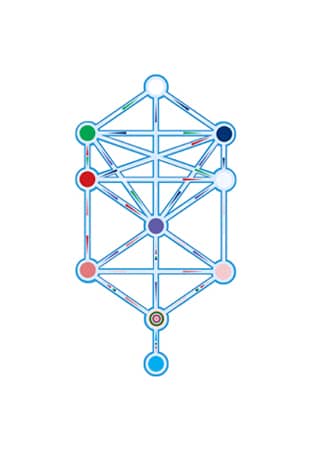
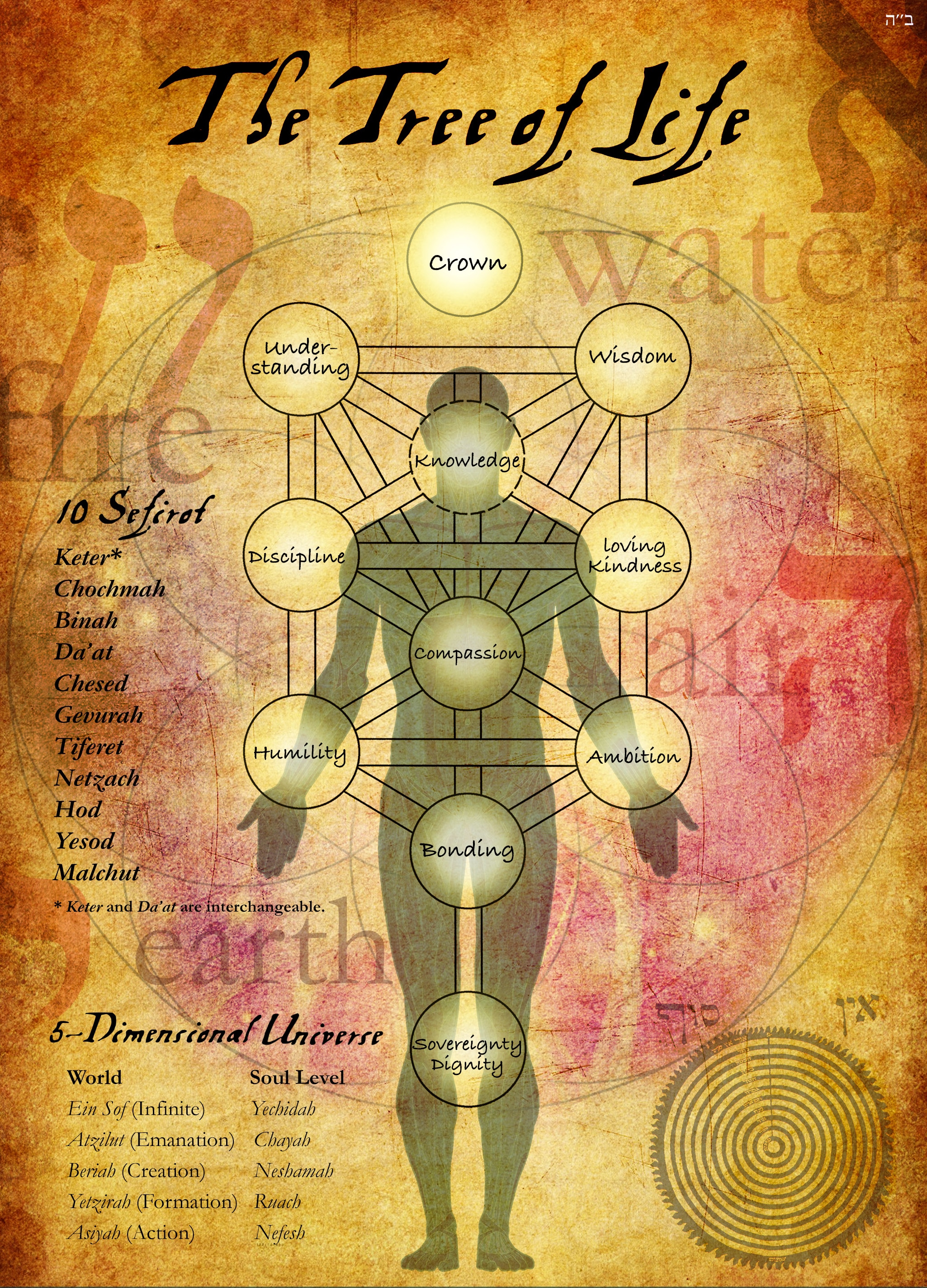
I’ll just use the classical example: fire and water, two of the most basic elements. In the Kabbalistic system, they’re building blocks, which we’ll discuss a little later. The building blocks of existence, of the universe, consists of ten spheres. Which gets complicated because these ten multiply many times over, but for instance when you say “water,” water is the physical manifestation of a spiritual counterpart called chessed, which is love.
So Kabbalah sees the physical world as metaphor and beyond metaphor. The soul of water is love. The soul of fire is discipline, fear. This also explains the colors of water and fire, blue and red respectively, each color having a corresponding dimension and personality.
Essentially, the Kabbalah is giving us a deeper internal map of existence, of phenomenon, of experiences around us. So when you talk about Kabbalah you should also add that it’s hard to quantify because the Kabbalah itself has many schools of thought (I’m talking about its origins), and I could break them down into categories:
There is Biblical Kabbalah, for instance, the Zohar is structured around the portions in the Torah, so the Torah has 52 portions, the Zohar has a section on each of those portions. So it essentially gives you the Kabbalistic interpretation of the Biblical stories.
But there’s another part of the Kabbalah which could be characterized as philosophical Kabbalah, an example of that would be the works of Reb Moshe Cordevero (the Ramak), a contemporary of the Holy Arizal (Rabbi Isaac Luria) who, in the 16th century, wrote a classical book called The Pardes, which means, The Garden, in which he discusses the philosophical dimension of Kabbalah. He explains issues such as G-d’s unity, of good and evil, etc.
And there’s a part of the Kabbalah which is very technical, called the kavannah, or inner intention of what a person should think about when he or she prays, the inner meditations, how each prayer, whether it’s the Shema or another prayer, it has a deeper meaning behind it.
So I just gave you three different, so to speak—not necessarily conflicting—schools of thought within the Kabbalah: Biblical Kabbalah (also called Classical Kabbalah), Philosophical Kabbalah, and Applied Kabbalah which is connected to how to pray and how you do a mitzvah, what you should think about, what you should meditate on when you give someone charity, things of that nature.
And then there’s a final category called Kabbalah maaseis, which literally means Kabbalah in action, but it’s applied Kabbalah where people used the mysterious names of G-d and different amulets not to perform magic, but to suspend the laws of nature. For example, they say that the Maharal of Prague built the golem, a “dummy.” It’s a famous story that in Prague the Maharal took dust from the ground and created this, so to speak, “Frankenstein,” but not a monster, but someone that protected the Jews at that time.
Feder: So there is an element of “magic” involved in this.
Jacobson: Well, that is the area of Kabbalah which should be most avoided because, first of all, do we have anyone today who really masters that? It can be very much abused, and it’s an area that I’d rather not discuss because I know so little about it. As I said earlier, those who know don’t say, and those who say, don’t know. So I’m in the category of if I say anything, you would clearly point out that I don’t know anything, so I’d rather not…
Feder: You mean, when it comes to the magical aspects of it…
Jacobson: Right. And also, as I said, if a holy person knows how to use that, it’s one thing, but for the rest of us it becomes a little more sensational than real, so it’s important to avoid the sensational part of it.
So essentially Kabbalah is a very vast, wide body of work…
Feder: You could spend your life studying this every day, right?
Jacobson: Yes. A body of work that goes back thousands of years, and different areas of Kabbalah touch upon different areas of interpretation as I described.
For those listeners who are academically inclined or are familiar with or interested in knowing some of the books involved, as I said, the Sefer Yetzirah is considered to be the first work, or the Raziel HaMalach as I mentioned earlier.
The Zohar (sometimes called the Holy Zohar) is the classical work of Kabbalah which was written close to 2,000 years ago, but there are other books that follow the Zohar, for example, the Sefer HaBahir, meaning, The Book of Illumination. (By the way, Zohar also means illumination). Often the names of Kabbalistic books are very connected to light, illumination. First of all, light is one of the metaphors used for Divine expression.
Now, after the Sefer HaBahir, there’s a book called the Sefer HaTemunah, The Book of Portraits, the Sefer Hakanah. Then a Torah commentator, Nachmanides, was a famous Kabbalist (I’m just going through the centuries), and then, one of the most famous of Jewish Kabbalists is Isaac Luria, who lived in the 16th century, known as the Holy Arizal, who lived in Sefat, in the northern part of Israel. He is considered to be the preeminent, not exactly modern, (in the last 500 years) authority on Kabbalah. In a sense, it passed on through him, who was considered to be a holy man, a mystic, and interestingly, his students were some of the greatest leaders, the people who codifed Jewish law (Joseph Caro), his other contemporaries.
Isaac Luria was the one who really revealed dimensions of Torah that were hitherto unknown, particularly in the area of understanding the cosmic dimension: how G-d creates a universe, how a human being interacts with G-d. One of the classical concepts that the Holy Ari revealed was the concept of tzimtzum.Tzimtzum means contraction of light, where he gave an analogy to understand how an infinite G-d could create a finite universe, and how do you bridge the gap of two such dichotomous, or antithetical realities like heaven and earth. He explains it with the concept of a tzimtzum, which is similar to a teacher who condenses or contracts his brilliant ideas in order to allow a small, narrow stream of information to flow to the student.
So that’s a metaphor used to understand this type of relationship. Now although this stream of light condenses it, it in no way compromises it, because within that information lies all the intelligence and brilliance of the master teacher.
Feder: You have to decode it.
Jacobson: Right. Decode it and climb the ladder. I want to continue regarding the Arizal. The Arizal had many students who continued to perpetuate the teachings, and these students became more and more known; as a matter of fact, the Arizal had a famous student named Reb Chaim Vital, who really was the one who wrote down all the teachings that he heard from his great master.
It’s interesting to note that the Arizal only lived to age 38, and most of his teachings took place in the last year or two of his lifetime.
So Reb Chaim Vital continued perpetuating these teachings and as the generations pass (the last 500 years), the birth of the Chassidic movement—when we talk about the chassidim, the Rebbes, the Baal Shem Tov—is, in a sense, a continuation of the Kabbalistic tradition with a Chassidic dimension in it, but it continued to perpetuate what is considered to be the inner dimension, the esoteric dimension of Torah thought.
Feder: And this developed in Central and Eastern Europe?
Jacobson: Right. And in essence it’s seen today by Torah authorities that though Kabbalah has to be studied in a restricted way, there are certain elements of Chassidic thought, based on Kabbalah, that are a necessity today to survive in a world that is so materialistic, and as we see today, many people are turning toward spirituality. It’s difficult today to just demand or ask many young people today to just follow dogmatically and blindly rules and laws… it sometimes requires the esoteric or spiritual dimension: for example, what this does for the neshamah, or soul. Even for people who are completely dedicated to tradition, though perhaps Kaballah itself is not what should be studied, there are elements of it which are gleaned and discussed in Chassidic teachings which are considered to be a mandatory study because it helps a person connect their Judaism, their commitments, their traditions to G-d and to having a personal relationship with G-d.
I think this is a brief overview, as brief as one can be in describing an entire body of work.
Feder: That’s concentrating a lot of material…
Jacobson: It would be like asking me, “What is medicine?” I just want you to understand that if someone didn’t know what medicine was, how would you capture it? So medicine, obviously, is the study of the body and how it works, but medicine has many schools of thought: you have neurology, the circulatory system, etc.
It’s the same with Kabbalah. Kabbalah is the study of the soul—to sum it up.
Feder: Which is in everything, right?
Jacobson: Exactly. The human soul within the human being and the soul within existence. And essentially as complex as the study of the body is, the study of the soul is equally as complex, if not more so because of its sublime and invisible nature. You can’t study a soul in the sense that you can’t put it under a microscope.
Feder: Okay. Let’s take a quick break here. You’re listening to Rabbi Simon Jacobson, and this is Toward a Meaningful Life with Simon Jacobson. My name is Mike Feder and we’re here every Sunday night from 6-7pm and you’re listening to WEVD, 1050AM in New York City.
This show is an outgrowth of the Meaningful Life Center in Brooklyn, and this show is also based very much on Rabbi Jacobson’s book called Toward a Meaningful Life, in which almost every subject that you hear discussed on the air here is discussed in the book.
We really want to thank everyone who has emailed us or written or called us. Here are some of the ways you can get in touch with us, and we want to hear from you. The most important thing is the telephone number: 1-800-3MEANING or 1-800-363-2646. You can also email us at wisdomreb@meanigfullife.com. You can always write to us at The Meaningful Life Center, 788 Eastern Parkway, Suite 303, Brooklyn, NY 11225.
I’d like to also tell you that we have a new website where you can download transcripts of this program, and previous and future programs. It’s www.meaningfullife.com.
Let’s just plunge right back into this because it is so fascinating to me. I just want to tumble in with these questions.
One or two questions to anchor it factually: I was looking in this “tome” I have, the Oxford Dictionary of Religions, which suggests or implied (and this may be totally wrong—every article doesn’t have to be right—because there may be some other influences that are not just exclusively Jewish influences that are in the Kabbalah) that there may be an interaction of various mystical traditions, perhaps even Christian or Eastern that may have gotten involved in this, because the truth is, a lot of what you’re explaining sounds very much like the core and essence of a lot of major religions in the world, where there’s a soul and a force which infuses everything.
Jacobson: My response to that would be that first of all, Judaism in general, is quite an ancient religion and tradition, and the other major religions either directly or indirectly follow Judaism. Christianity and Islam particularly, both historically in time, but also their basis is that first there was the prophet Moses, and so on and so forth.
So I would say that they have been influenced by Jewish thought rather than to say that they influenced Jewish thought, because Jewish thought preceded that. And I’m not pulling rank here, but the fact is, that Islam and Christianity came later.
Feder: But Eastern religions?
Jacobson: Regarding Eastern religions, interestingly (and I’m not trying to monopolize anything), but the fact is that the Bible says the following statement: Abraham sent some of his children and students to the East and sent them with many gifts.
The consensus is that the gifts were wisdom. Now, you’ve heard the term Brahman? Many attribute that to Abraham (Ibraham).
Feder: Is that like an actual word root there?
Jacobson: Yes, definitely. Actually Brahman is a rearrangement of the letters in Abraham. Because the source of Abraham—even in Islam you say Ibraham.
Feder: Ibra-him.
Jacobson: So Brahman is very much connected and associated with that. Now, this by no means is trying to suggest that there’s no legitimacy to the other systems, but I frankly see parallels between different mystical systems as a tribute that there are certain eternal truths that are ingrained in our systems.
You, Mike, may never have studied any type of mysticism yet there are certain truths you may have come to through your experience—either good experiences or painful ones…
Feder: Just by being a human being.
Jacobson: Right, exactly. And the fact that you meet someone somewhere who says, you know, that’s a very mystical concept or idea, just from my point of view, just testifies to the truth that truth resonates, and you will find it many different places, sometimes through individual search, sometimes in a more formal way.
I would say that Kabbalah is a formal text and scholarly work that documents it all, but much of it does exist, and you will find parallels of it, in other systems. And my style is not to go ahead and make comparisons, i.e., which is better, etc., but the point is that truth is truth and it resonates.
The similarities that the universe is not just a material machine, but there’s a spirit behind it, is obviously universal to all spiritual/religious schools of thought and that’s great.
Now regarding the actual discussion itself, how that soul is understood, you will find differences in different schools of mysticism. But the Kabbalah is a very self-contained system and doesn’t really depend upon or lean on other systems. It has its own rules and its own approach, and I would rather leave it to the student to compare and say, okay, how does that compare to other schools of thought…
Feder: Since you mentioned such a good answer to that question, since you mentioned student, you said before, and I think everything you’ve said before more or less answers this question but I’ll ask it again, that this is the kind of thing that’s traditionally studied person to person, in other words, this is taught from a master to a student. This is not the kind of thing that you get a whole bunch of people in a classroom or auditorium like in a university and you lecture them about it. Now why is this?
Jacobson: Good segue. As I mentioned earlier as well, Kabbalah means reception. And it’s interesting that a mystical study or esoteric scholarship should be called reception. Now there are seemingly other names that you can give it. But I think there is an inherent component in the word reception that really captures the power of Kabbalah and that is, that it’s not just an academic study of facts. It really is an experience more than a study. And experience, as we know, cannot be passed on through fax machines and computers and books alone.
Feder: Or lectures.
Jacobson: Right. You need the human touch. So it’s not incidental—you know, in some systems it’s incidental, that is, the only way that a student can study is that there needs to be a teacher. But in Kabbalah it’s inherent that it be studied teacher to student, because that teacher knows what’s between the lines—the spirit, the experience—so it’s almost like a guide who’s teaching you how to live it, not just how to understand it.
Kabbalah is much more about living than understanding. That’s why the Kabbalists were also very careful whom they taught because they didn’t want it to become detached from a person’s life. In other words, the most vulgar thing, the most abusive thing for a Kabbalist would be if someone studies it and behaves contrary to what they studied. In other words, personal refinement goes hand in hand with the study.
Feder: So in other words, a student, and this is the same in other traditions, has to prove that he or she is truly interested and sincere before he is accepted.
Jacobson: Right, exactly. And that’s the only way that that student would be worthy. So that’s one concept, the idea of a “chain” of teacher to student and human experience that’s passed on, that goes beyond words, that can’t just be documented on paper.
An additional point is that the Kabbalah also means that the state of mind that you have to be in when you’re studying it is not of an arrogant, egotist who’s a master…
Feder: Ah. Receptive.
Jacobson: You feel like you’re receptive. You have to feel like you’re a receptacle. And interestingly, that would lead to the final point I want to make which is that essentially the Kabbalah is meant to teach us how we all become receptors, that we are all really here on earth to be a channel for higher truths.
See, most of us, or all of us initially in our lives, are self-contained individuals—with an ego—and our main agenda is to take care of ourselves. So essentially, you’re here to serve yourself.
One of the primary teachings of the Kabbalah is, no, you’re not here to serve yourself, you’re here on a mission to serve a Higher cause. And your personality, your talents, your strengths, your unique faculties are really all channels for something greater and higher.
Now, creative people talk about this a lot, about being a channel for higher wisdom, for example, they say, I allow it to travel through my arm, my hand.
Feder: A lot of writers say that they take dictation rather than think it themselves.
Jacobson: Right. But in the Kabbalah it’s more comprehensive in that all your life is dedicated to that. You sit down at a meal, you walk in the street, you’re running your business. So even if you’re not a Kabbalist, the message of Kabbalah is that you’re here to be a channel, you’re not just here to sustain yourself, to make money, to eat, indulge and have fun. You’re here to be a channel, a receptacle, Kabbalah, to be like an open container, to be receiving something greater and it should be channeled through you into this world, and in some way transform your little corner.
That is, in essence, one of the most important and relevant messages of the Kabbalah to each of us. So in that context you understand why it’s so critical to be taught in the right environment, or else, it lends itself to exotic sensationalism.
The fact is, people often ask me about palm reading, fortune telling, seeing the future, stars, astrology, dream interpretation, reincarnation. Now, take any one of these topics, and people perk up. And I always wondered why. Is it because they’re so academic and intellectually curious?
I would say that most people perk up because it’s exotic. It’s exotica, it’s unknown. It’s the curiosity that each of us has in the area that’s unknown. That’s one part of it. Another part of it is that in some way if it’s not dealt with maturely, it’s almost like a distraction, like a cop-out. That if you knew that you were a frog in a previous lifetime or something else, then it almost explains your life. Or if you knew your future destiny it frees you of responsibility in a way.
Feder: So you’d be fatalistic and you wouldn’t aspire to anything higher or change.
Jacobson: And unfortunately, or really fortunately, life is not that way. We were empowered with free will. It may not be wise for you to know your destiny and exactly what will happen in the future, or where you come from, what you were in previous lives.
If that knowledge helps you to be a better person and live your life in a more responsible way, it’s one thing. But I would tend to think that many people, when they know that, do not necessarily become more responsible, it’s a flight into a world that is exotic, unknown.
As I heard once, a person once asked a Rebbe to interpret some of his dreams. And the Rebbe said, I have enough problems figuring out what to do when I’m awake before I get into dreams.
Now there’s much about dream interpretation
Feder: In the Kabbalah?
Jacobson: In the Kabbalah, definitely, and you find it even in the Bible with Joseph interpreting Pharoah’s dreams. It’s a certain language, a certain secret language of the soul, the psyche.
Feder: You think Freud picked some of this up?
Jacobson: Freud definitely looked into those books (I don’t know if it was specifically the Kabbalah) but you definitely see references to Jewish mysticism in his writings.
The thing I wanted to say was that even though there’s much about astrology and the stars and the powers of the cosmos, nevertheless it has to be carefully taught or else it merely compensates…
Feder: So you’re saying that there are places in the Kabbalah where these things are taught?
Jacobson: Yes. Any true authority will not just teach it easily, because he or she will risk the fact that people may abuse it by just that curiosity of knowing, for example, what my future holds, what my palm reads rather than really assuming responsibility. So it is really a mature study that can only come, and is coupled with, a very mature attitude that this does not replace or compensate for, is not an alternative to, real hard choices in life.
Feder: So the study of the Kabbalah is not for children or young people really.
Jacobson: Children and not just chronologically. It may be for a child who’s an adult, meaning, it requires a mature approach to life, number one, that you’ve taken hold of your own life, your control of it, your choices are refined, you’ve shown responsibility.
For someone who has not really assumed responsibility for their own lives in a very serious way, if they go to a true Kabbalist, he won’t laugh but he won’t teach them any Kabbalah. It has to be earned. In the Talmud, the metaphor for an ecstatic experience is “entering the garden.” You can’t just enter the garden easily.
There’s a famous story in the Talmud where four people entered the garden. They went into an ecstatic state, a state of mystical and spiritual ecstasy, and three of them did not survive, did not come out intact. And they were great, great sages. One came out insane, one died, one became an apostate. He was overwhelmed and confused and unable to relate to certain things he witnessed and experienced. Rabbi Akiva was the only one who “entered in peace, and exited in peace.”
It teaches you something. You see, a person has to earn certain journeys in life. If you don’t earn it, then you go there and you come back and it’s not really you, you can’t internalize it. I don’t want to compare it, but it’s similar to getting a high through an alternative foreign substance. You haven’t really earned it, you’ve almost jump started something and entered a place that you haven’t earned the right to enter into.
So you see things that you don’t appreciate or don’t know what to do with when you go back to your life, which is why there is burn-out. You can’t ground it, you can’t internalize it.
Kabbalah is not, G-d forbid, a drug. But in a similar way it is an experience that is of a greater nature, which has a certain awesomeness. You have to be receptive to it, you have to be ready to receive it, you have to also be mature enough to say, you know, I’ve heard enough and I don’t want to jump in.
Feder: I’ll stop here for a while, right?
Jacobson: It’s a question of growth.
Feder: It’s interesting that you used the word “burn-out” before. In every religious tradition that I’ve ever heard of, people who are not prepared, and that’s most of us, if they see the “face of G-d” in any religious tradition, or are brought too close to the great profound meaning of something, it often either kills them or blinds them. These are experiences that are written about in every major religious tradition.
You have to be ready for it.
Jacobson: Right. That’s why the Mishneh says that the “Maaseh Merkava” should be studied only individually, not in groups. The “Maaseh Merkava” means the “vision of the chariot” which is one of the Kabbalistic visions in the Bible that you find in Ezekiel, the prophet who had this vision. And he saw a chariot with four faces and describes it in detail. It’s actually a lot of Kabbalistic metaphors that are understood only within Kabbalah, and that study of the maaseh merkava is not meant to be studied except individually, not in groups, because a group tends to dehumanize, depersonalize the message and it’s good for scholarship for it’s not good for experience, because experience is always individual.
Feder: So the experience gets diluted too much.
Jacobson: Right. That’s why these things are not studied in groups, but rather individually, teacher to student, face to face. It’s a very personal type of journey.
Feder: So there are people now who are studying Kabbalah. As we speak, there are people out there in the world who are studying this, right?
Jacobson: I can’t speak for everybody, because some people may be studying it which means they may think they’re studying Kabbalah but it doesn’t mean it’s Kabbalah.
Feder: You mean they might be reading a book someplace…
Jacobson: It may even be an authentic text but not necessarily that they understand or appreciate what they’re reading. Now I’m not here to judge anyone or to pass judgment on any school of thought. I think there is an inherent immune system in the Kabbalah.
As I said, those who really know don’t say and those who say don’t really know. So does that mean that every teacher doesn’t know? If he says everything, then he probably doesn’t. If it’s too sensational, too commercial…there are certain signs that usually signal that something’s wrong. The real mystics in history, the real humble people, the real masters, would be the first to say I don’t why you’re coming to me… So as soon as you see that it’s more of a sensationalistic thing, a publicity thing, a celebrity thing…
Feder: But you started out the program saying that it’s become a popular thing, like a fad. What is that all about?
Jacobson: I just made it as a statement, I didn’t say it in a positive or negative light.
Feder: But it is true.
Jacobson: Yes. That’s a fact; that you can’t argue. My attitude to that, as I’ve often stated, is that for good or for bad it brings attention to it, and it’s a good opportunity to get people thinking and get people to fully understand it. Clearly, whenever anything is on that type of popular level, there’s always going to be distortions—it has to be that way.
Again, I’m not here to speak about any individual or any particular school of thought, but I think there are certain questions that anyone studying Kabbalah should ask of the teacher. Number one is the issue of receptivity: who did you receive from?
Feder: In other words, whom did you learn from?
Jacobson: Right. Who’s your teacher? Who have you humbly sat before? Without that, this isn’t an ego trip, this isn’t an individual creation. Kabbalah is not owned by any individual, and it can’t be sold by any individual; there’s no monopoly, no royalties. It’s a wisdom that is inherent in existence, part of G-d’s creation, and therefore cannot be monopolized by any one person.
In addition, the humility of the teacher is critical; what kind of humility that teacher has, what modesty they carry.
So though there may be people who know the information, it doesn’t necessarily mean that they are what I would call a Kabbalist. A Kabbalist is not just a knower of information, it’s a true receptacle, a true humble teacher or actually a student, who simply allows himself to be a channel for that type of wisdom.
Feder: So the teacher is always a student.
Jacobson: Always. As a matter of fact, in Hebrew, the word for a true teacher is talmud chocham, which means the student of a wise person. You don’t call him a wise man, you say a talmud, the student, the disciple of the wise.
Feder: Now you presumably have studied this with someone.
Jacobson: Well, that depends on whether or not you consider me to be a Kabbalist or just someone with knowledge about the Kabbalah. I didn’t make any such claim. I think it’s a good topic to discuss on a show, but I would not categorize myself as a Kabbalist. I would say I’m familiar with Kabbalah and I can tell you that I studied it and read about it, and had a master, particularly the Rabbi Menachem Mendel Schneerson, called “the Rebbe,” who was clearly a mystic and a Kabbalist, but if you look at how he taught, he never really sat down and taught Kabbalah, it was always integrated within a system of life, how to live your life. If you were to ask him if was teaching about Kabbalah, he would always say no he’s not teaching Kabbalah, he’s teaching you how to live your life. But within that was woven Kabbalistic teachings.
So in that context I could say that I studied Kabbalah, but out of curiosity I read the books and I’m familiar with the body of work. But I would not call myself a Kabbalist.
Feder: In other words, if someone came to you and said I’d like to study that with you, you really wouldn’t…
Jacobson: I would invite them to my Wednesday night class where I try to weave it in as well. But I would not call it a class on Kabbalah. But if someone calls it that, that there’s Kabbalistic teachings taught there, that’s fine with me but if you asked me what Kabbalah is, it’s far beyond…
Feder: Now in this book of yours, Toward a Meaningful Life, upon which this show is based, and just to mention the book Toward a Meaningful Life by Simon Jacobson is published by William Morrow and you can go out and buy it and read a copy of it. Would you say that there are some Kabbalistic teachings that have found their way generally into it?
Jacobson: Oh, definitely. It may not be overt because I stayed away from using prohibitive language (Hebrew and description of concepts that require an advanced understanding of these teachings), for that matter anything too esoteric, because I wanted to make it more accessible, but particularly in the chapter on G-d and the chapter on Unity you could almost call them an introduction to Kabbalah. I’m big into introductions. I could say I could give a good introduction into Kabbalah; whether I could teach Kabbalah is another story.
An introduction to Kabbalah may even be more valuable than even studying Kabbalah because it’s appreciating what the system is; for instance, I mentioned earlier this idea of building blocks—the idea of the ten spheres, the four worlds—it’s a fascinating map of life that Kabbalah draws, and it helps make sense of our lives and understand deeper forces at work in our lives.
Feder: This brings up an obvious question, since we’re talking about studying this subject. Do you have to be Jewish to study Kabbalah? I mean, if you were truly seeking, and ready, could a person come from any tradition to learn Kabbalah?
Jacobson: It’s a difficult question to answer because I have to go back to what the Kabbalah means. I remember once there was a traditional Jewish person at my class who said, “How could you be teaching any Kabbalistic concepts in this class?” There are prohibitions not to teach it to people under 40, and certain other restrictions that I mentioned earlier. So I responded by saying, “Every morning we say in the Jewish prayer, in the liturgy, ‘Modeh Ani,’ we acknowledge G-d for returning my soul to me.”
So if your five-year-old child were to ask you, “What is this thing ‘my soul’?” Would you tell your child, you can’t study that until you’re 40 years old?
Obviously not, that’s ridiculous. A soul is something we carry from birth, before birth. It’s part of our lives. To give children a spiritual education doesn’t mean you’re making them into Kabbalists. So your question is a good question but I want to split it into two. I think that if most people knew the basics of spirituality today, that’s really what’s missing. Not Kabbalistic teachings, per se. Kabbalah is a more intense study once you’ve accepted that there’s a soul and there’s a G-d, and you have a relationship with that G-d. I believe that when I meet people today that people are missing the basic element of spirituality altogether. That’s not Kabbalah. You don’t need Kabbalah for that.
You can say obviously that it stems from Kabbalah, but it’s like the A-B-C’s. It’s the first thing and you don’t even go further. Kabbalah comes in once you know all that and then you want to know, “How do you pray to G-d, How do you build the relationship to G-d?”
So let’s take love, for example. Today we’re just trying to establish a relationship that works, let alone a deeper exploration of it. Kabbalah is a deeper exploration of it. So when you ask me the question, this is how I would respond: Yes, to that universal dimension that all of us need, the basic principles and fundamentals of spirituality in our lives, that part of Kabbalah is for everyone and should be taught and should be encouraged because it is the key to being a productive and a responsible human being, a spiritual, transcendental human being.
But regarding the deeper dimensions and the deeper explorations, there are prohibitions and limitations and that would be case by case, and depending on whom.
There are great non-Jewish leaders in history. Bilaam, for example, was a prophet. He clearly had knowledge of Kabbalah, so it’s not an exclusively Jewish study, but on the other hand, even among Jews themselves there are limitations. It’s not like anyone can just study it.
So really when we’re talking about the basic elements of spirituality, they are for everyone. The deeper exploration depends on the individual: where they’re at and what they’re doing.
Feder: Well, it’s interesting growing up in what’s considered a Conservative or Reform background, and perhaps millions of American Jews are brought up in this tradition. I had never even heard the word Kabbalah my entire life until I was studying religions in college. I was not brought up to even know that word or that tradition.
Jacobson: I had a student (a student! He’s older than I am) but he came to one of my classes and he said to me that until he came to this class he never knew that Jews believed that there’s a soul. I mean this, it’s not a joke. He never heard the word soul until he heard it was in Buddhism as a teenager. He didn’t hear it at his bar mitzvah, he didn’t hear it in his Hebrew school classes.
I don’t mean the actual word, of course he heard the word soul, but it was never used, it was never an element in experience. He never heard: okay now this is going to be a soul, a neshamah experience. It was always very traditional, very technical, “Just do it,” type of thing. And it was more that you have to fear G-d: if you don’t do it, G-d will do this or do that.
Feder: I remember that part.
Jacobson: So unfortunately, with such a rich spiritual tradition of Judaism, many Jews today are finding their spirituality elsewhere, because what they were taught in schools was exactly the way you described it. It was a very dry, hollow, non-resonating experience. And the soul searches for nourishment. If it doesn’t find it in its own backyard, it will look elsewhere.
Feder: You know, you’ve mentioned your class several times this evening. I’m wondering, if people are interested should they call up and find out where it is?
Jacobson: They can just come. Everyone’s invited to the Wednesday Night Class in New York City, every Wednesday night at 8:30pm, at 346 W89th Street at Riverside Drive.
Feder: On the Upper West Side.
Jacobson: You sound like you’re an Upper West Sider.
Feder: I might be.
Jacobson: You sound so proud. But there’s no discrimination. Anyone from the Upper East Side, the Lower East Side is welcome. It’s a very eclectic group and I think most people would find it interesting. It’s very open, as opposed to radio you can directly argue and you can’t be hung up on there.
Feder: Okay, so now we’re coming in toward the end of the show. So let me share with you that we have underwriters, people who support these programs, and the name of the underwriter of tonight’s show, the person who has brought this show to you is Richard Blackstone, and thank you very much for making this show possible.
Jacobson: And I second that. Mr. Blackstone, I really appreciate all his work in supporting what we’re doing here.
Feder: Now, I should also say that speaking of underwriting and helping to support all the work and the work of the Meaningful Life Center, we have received many requests from people asking how they could donate to the Meaningful Life Center, which of course brings you this radio show every week.
The Meaningful Life Center is a non-profit organization dedicated to bringing a sense of peace, light, inspiration and meaning into the world. All its activities are made possible by donations from people like you who are listening to us right now, people who receive the Center’s publications and tapes, who listen to this program and visit our website.
When you contribute to the Meaningful Life Center, you become, in effect, a partner in the work that Simon Jacobson is doing. So we’re asking you to consider funding these radio programs. It’s a great opportunity to perhaps honor someone you love, and bring inspiration to thousands of people when they hear these programs.
You can dedicate a program to the memory of a loved one, someone’s birthday or wedding, or any other occasion. We really do need your help. We want people to feel like they’re part of this and to bring this radio show to people.
A donation of any amount from a dollar—but we’ll accept a hundred thousand dollars—is appreciated. You can call 1-800-3MEANING (1-800-363-2646) to take your pledges of support. And when you pledge, when you help us out, make sure to ask to receive our newsletter Meanings. And remember, we don’t have any commercial sponsors here. We like to bring you as much information as possible without being interrupted by commercial sponsors, so we count on you, the listener, to make this show possible.
I think that does it as far as our business. Now, we have just a few minutes left. The Kabbalah, being such a complex, profound and difficult thing—and you’ve really given us just the briefest description of it tonight, and you say it’s a concentrated thing that has to be decoded, so here’s my question.
We, the people who don’t study it, the people who are living our lives, who are going to take the subway home tonight, or are going to go someplace, or wake up tomorrow morning and go to work. What does this great thousands-year-old body of wisdom, perhaps as old as human beings themselves, what can it do for us, for people listening to this show, and for me sitting here. What can we take with us into the world? I mean, it’s there to be studied, but we’re not going to be studying it tomorrow or the next day.
Jacobson: These shows that we’re doing here today, Mike, and the ones that will follow, in a way, have many Kabbalistic roots in some of the teachings that I’ve been steeped in and that I base some of our discussions here. They have elements of Kabbalah and certainly the spiritual dimensions of our discussions. I intend to dedicate many shows to different topics that are Kabbalistic, and I believe that we should a few weeks from now perhaps dedicate a show to reincarnation, afterlife: topics that people struggle with, death, life, and not in a sensational way, but in a meaningful way.
But to answer your question, I’d like to reiterate or perhaps rephrase something I said earlier. The Kabbalah’s main teaching is that we’re not alone in this world, and we are channels for higher energy. Each of us has something to contribute that’s unique: we’re on a mission. And we are receptacles to use our strengths, our talents, our unique opportunities to reveal a deeper spiritual dimension in everything we do. In a sense, to spiritualize the material world we live in. That means from when we take the next bite of food in our mouths, it’s not just an act of sustenance or indulgence, but rather a spiritual act, as Kabbalah will teach, that there are spiritual sparks in that food.
Feder: So every single thing we do, day in and day out, on a daily basis is a sacred act in a way…
Jacobson: Exactly. One of the Kabbalistic teachings is the concept of redeeming or redemption/elevation of the sparks. This means that we tarin ourselves to see and experience spiritual “sparks” in every fiber of existence, in all phenomenon, in every interaction — the sparks are scattered all over. Every time you meet a new person or someone that you know, there’s a spark to be revealed or redeemed in that experience. Every time you eat something, every time you travel somewhere, there are sparks to be revealed. This recognition changes, in an unbelievably gratifying way, the way we life our lives. There are no random things. Wherever you go and whatever you do, there’s a spark there for you to bond with, for you to connect with. In addition to that, it also gives a sense of urgency, a sense of purpose to things that we do. It’s not just, what difference does it make if I act this way or move that way.
Feder: Or I can waste a few hours.
Jacobson: Right. Every little act takes the world for a cosmic spin, so to speak. In addition, another Kabbalistic teaching is that a human being is a small universe. Today we live in a world where quantity and quality have ceased to be compartmentalized. We understand that a little quantity can change a major quality; one dot in a computer program can wreak havoc. One mutation of a cell, G-d forbid. A butterfly effect: one little vibration in one corner of the world can cause who knows what.
So we understand today that matter and energy are interchangeable. This is an essential Kabbalah teaching, that matter can be converted into energy. That even a small little act of kindness changes the world in some way. The fact that we don’t always see it is that we’re small people ourselves. Our vision is myopic, narrow. But there are deeper things going on, and it’s also a way of looking at the world around you, including your experiences, and seeing it through, and seeing that there’s a bigger picture emerging. So Kabbalah, coupled with, fused with, the entire body of tradition, the body and the soul, create a full dimensional experience.
A person can do something, can follow a law, but it they don’t respect the spirit in it, or they don’t have the spirit, they’re missing an important dimension. On the other hand, Kabbalah alone—spirit without the actualization in a concrete act—in turn is only a spiritual experience and doesn’t make an impact on this world and is therefore not sufficient.
So I would encourage people to continue to listen to this show, and to pursue in other ways (look at our website and the links) to explore the fascinating treasure and journey which is the Kabbalah, and Kabbalah in the context of all of Judaism, and all of tradition, including its universal message that we are here on a mission, and we are here to fuse body and soul.
Feder: Thank you.





I have found this article about the Kabbalah very enlightening..
As I am a student of it in the western tradition..
D
Excellent introduction on Kabbalah, thank you so much, Rabbi!
… [Trackback]
[…] There you will find 11776 more Infos: meaningfullife.com/kabbalah-inner-journey/ […]