
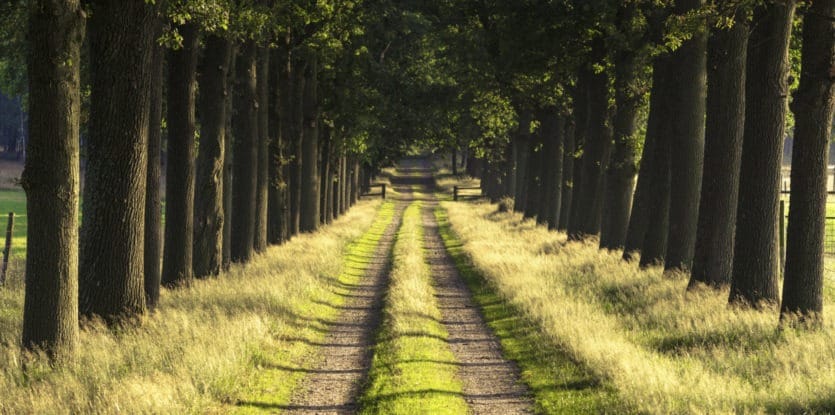
The court is obligated to straighten the roads to the cities of refuge, to repair them and broaden them. They must remove all impediments and obstacles… bridges should be built (over all natural barriers) so as not to delay one who is fleeing to [the city of refuge]. The width of a road to a city of refuge should not be less than thirty-two cubits[1]. “Refuge, Refuge” was written at all crossroads so that the murderers should recognize the way and turn there.
Mishneh Torah, Laws Regarding Murder and the Preservation of Life, 8:5
The “cities of refuge” were six cities in the Land of Israel designated as havens for murderers. A person who killed would flee to the nearest city of refuge, where he would be safe from the vengeance of his victim’s closest relative (the “avenger of the blood”) until he was brought to trial before the sanhedrin (a tribunal of twenty-three judges that tried capital cases).[2] It was the court’s responsibility to ensure the accessibility of the cities of refuge by improving the roads leading to them and posting signs with the words miklat, miklat (“refuge, refuge”) to show the way.
On the spiritual plane, there also exist six “cities of refuge” for the spiritual “murderer.” Life, in the true and ultimate sense, is connection with the divine source of being and vitality;[3] an act of transgression against the divine will is a subtle form of “murder,” as it hinders the flow of vitality from G-d to creation. The words of the Torah, say our sages, are the “cities of refuge” for the destroyer of spiritual life;[4] if he flees into the Torah and immerses himself in it, the Torah will protect him from the adverse results of his deed. Specifically, there are six “constant mitzvot” that apply to every Jew, at all times, and in all circumstances, so that they are readily accessible to one who seeks refuge from his faults and failings, whomever he might be and wherever and whenever the desire to rectify his life might strike him.[5]
But a haven is of little use if it is inaccessible or its location is unknown. As is the case with the physical cities of refuge, it is the community’s responsibility to “straighten the roads… to repair them and broaden them… remove all impediments and obstacles” and post signs at all crossroads.
This imperative has special meaning to us today, when the roads of life are teeming with spiritual refugees. It is our sacred duty to station ourselves at all the crossroads and serve as living signposts, calling out “Refuge! Refuge!” and pointing the way to the haven of Torah.
Based on an address by the Rebbe, Shabbat Parshat Mattot-Massei 5712 (July 19, 1952)[6]
_______________
[1]. Approximately 48 feet.
[2]. If the “avenger of the blood” killed the killer outside of the city of refuge, he was not punished; if he did so inside the city, he was tried as a murderer.
In those cases in which the sanhedrin determined that the killing was unintentional (though due to the killer’s negligence), the killer was returned to the city of refuge to serve a sentence of exile, during which the city continued to protect him from the “avenger of the blood.”
[3]. Deuteronomy 4:4; ibid., 30:20; Talmud, Berachot 18b.
[4]. Talmud, Makkot 10a.
[5]. The Torah contains 613 mitzvot, or commandments. However, the great majority of them require certain circumstances to obligate and enable their fulfillment: there are mitzvot that can be observed only at certain hours of the day, or only on certain days of the year; mitzvot that can be observed only in the Land of Israel, or only in the Beit Hamikdash (Holy Temple); mitzvot that pertain only to men, only to kohanim, only to employers, or only to farmers; and so on. But there are six mitzvot (to believe in G-d, to avow His oneness, to renounce idolatry, to love G-d, to fear Him, and to avoid temptation to sin) that pertain to all times, all places and all individuals. Thus, there are six readily accessible “cities of refuge” for the errant soul (see introduction to Sefer HaChinuch).
[6]. Likkutei Sichot, vol. II, pp. 363-366.






the cities of refuge were only a haven for UNINTENTIONAL KILLING, not for MURDERERS, which killing was INTENTIONAL.