
by Dovi Scheiner
Haman[1] was in high spirits as he exited the palace gates. His hateful plot, calling for the destruction of the Jewish people, had just received the endorsement of King Ahasuerus.
In the distance, Haman spotted his arch-enemy Mordechai, who had encountered three young Jewish students as they were returning home from school and had paused to engage them in conversation. Haman edged closer to overhear their discussion.
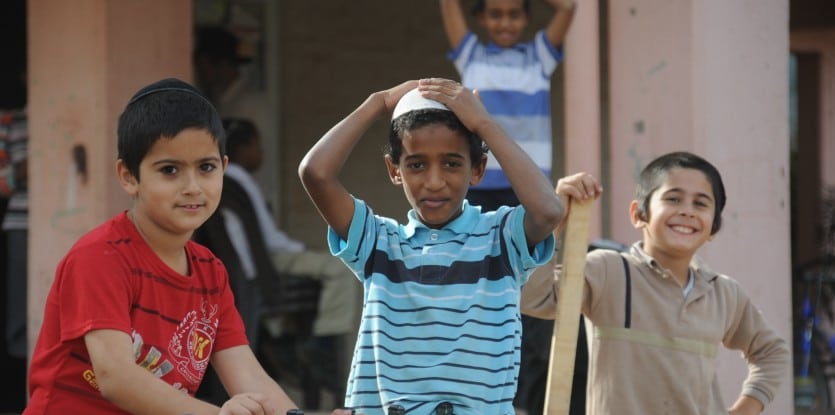
“What did you learn in school today?” Mordechai questioned the children. The first child replied, “Do not fear sudden terror, nor the destruction by the wicked when it comes.”[2] The second child responded, “Contrive a scheme, but it will be foiled; conspire a plot, but it will not materialize, for G-d is with us.”[3] “To your old age I am [with you]; to your hoary years I will sustain you; I have made you, and I will carry you; I will sustain you and deliver you,”[4] answered the third child.
Hearing the childrens’ replies, Mordechai’s heart brimmed with joy. Unable to contain himself, Haman approached Mordechai demanding that he explain the sudden improvement in his mood. Mordechai responded, “I rejoice in the good news the children have brought me, that I should not fear the evil plot you have conspired against my people.” Haman became enraged, vowing that when his plot materialized, he would strike the children first!
Haman’s plot imperiled the fate of the entire Jewish people. In this extreme period of crises, the eyes of every Jew focused on their leader Mordechai, wondering what his response would be. Remarkably, upon becoming aware of this grave threat, Mordechai’s first act was to engage a number of school children in conversation. What did Mordechai hope to glean from the children and what was it about their message that reassured him?
The hearts of the children that Mordechai encountered were full with faith. Their comments reveal their reliance upon G-d in dealing with three kinds of struggles. The first child speaks of faith in its simplest form, when faced with devastation and destruction. When “the destruction by the wicked comes” and all hope seems lost, G-d may still be found. Our faith in His underlying beneficence and compassion helps us withstand our most painful struggles. The second child has faith that “the plots of our enemies will not materialize.” He expresses the belief that G-d is at all times working for our protection, even where we are unmindful of impending danger. The third child shows faith in the face of the seemingly inescapable frailties accompanying “old age.” As nature takes its course, we trust that G-d is “with us,” to help “sustain and deliver us.”
Faith forms the foundation of our people. Through our faith we connect with G-d and in the merit of our faith we are afforded Divine protection. Mordechai appreciated that when our faith is firm we are invincible and that when our faith falters we become vulnerable. He knew that the people had compromised their relationship with G-d, when they bowed before a “statue of gold”[5] erected by King Nebuchadnezzar, whose reign preceded that of Ahasuerus by some thirty years.[6] Mordechai wandered the streets of Shushan in search of a definitive sign, a clue to clarify the true standing of the ongoing relationship between the Jewish people and G-d. He knew that the fate of the Jewish people now, as always, relied upon the state of their faith and dedication to G-d.
Mordechai wandered and he wondered, but when he encountered the young students returning home from school, he wondered no more. As Mordechai experienced the unblemished faith held by these children, he knew that the heart of the nation was in the right place, or, if not yet, that it would soon be. In so eloquently expressing their unbending faith in the deliverance of the A-mighty, in the face of oppression both potential and actual, the children reassured Mordechai that the soul of the people stood steadfast and secure. In the event that the elders could not match the intensity of these youngsters, the children could be counted on to fan the flames of faith.
So how do you take the pulse of a people? You speak with the children! In the running of a nation, the youth comprise the engine. If we teach our children to fear none other than Almighty G-d, then they will in turn inspire us to truly connect with the very values we preach. In the merit of the pure faith of our children, our people will forever stand secure, as we read in Psalms, “Out of the mouths of babes and sucklings You have established strength, because of Your enemies, to silence foe and avenger.”[7] Now more than ever, this is a lesson we cannot afford to overlook… our “homeland security” depends on it!
Adapted from a talk of the Rebbe, Purim 5726[8].
By Dovi Scheiner. Adapted from the teachings of the Rebbe by Yanki Tauber.
[1] Midrash, Esther, 7/17
[2] Proverbs, 3/25
[3] Isaiah, 8/10
[4] Isaiah, 46/4
[5] Daniel, 3/1
[6] Tractate Megilla, 12a
[7] Psalms, 8/3
[8] Likkutei Sichos Vol. 21, Pages # 206-213.)