And so you shall eat it: your hips girdled, your shoes on your feet, and your staffs in your hands. Eat it in haste, it is a pesach (passover) offering to G-d.
Exodus 12:11
Our endeavors in life can be divided into three general categories. First there is the tending to our own needs, developing our potentials and improving our character. Then there is our involvement with our surroundings: we each have our own “miniature world”–our family, profession, social circle, the natural resources we consume or develop–the people and things we come in direct contact with and influence for the better or (G-d forbid) for the worse. Finally, there is the macro-universe: world events, historical development, creation as a whole. While many of us might consider this beyond our sphere of influence, our every act and endeavor deeply impacts the world we live in, whether we are aware of it or not.
Passover marks our birth as a nation—the time that G-d extracted “a people out of the bowels of a people,”[1] granted them the gift of freedom, and empowered them to realize His goodness and perfection in their own lives and in the world He created. A key theme in the story of the Exodus is “haste”: the children of Israel are described as having “fled” Egypt;[2] matzoh is the bread that didn’t leaven because we were “driven from Egypt and could not tarry”;[3] and the pesach offering, the key to the redemption and the axis around which the entire festival of Passover revolves, was eaten “in haste.”[4] The haste of Passover emphasizes that life, for the Jew, is never again to be the passive and static experience it was for the clan of Hebrew slaves under Egyptian bondage. Life is to be a vigorous, energized movement forward, an unceasing quest to advance and achieve.
The state of haste in which the first seder in Egypt was held was expressed in three ways: “your hips girdled, your shoes on your feet, and your staffs in your hands.” These correspond to the three dimensions of the forward movement of our lives outlined above: our self-development, our effect upon our immediate surroundings, and our universal role.
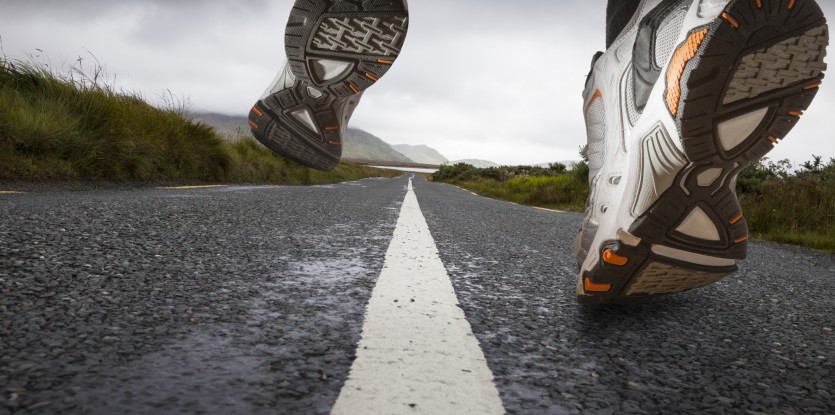
The hips, which are “the base that holds up the entire body,”[5] represent the human being as individual. The feet are the person’s means of locomotion, with which he moves from his private space and concerns to make contact with his fellows and with his environment. Equip the feet with shoes and you enable them to negotiate their way through hostile terrain that would otherwise impede their movement from place to place. Shod feet thus represent our ability to journey from the enclave of self to influence individuals and places that lie beyond the range of a “barefoot,” home-bound personality.
But man is more than a foot traveler in life. Man is unique among his fellow creatures in that he makes extensive use of “tools”—implements he fashions that enable him to manipulate his environment in ways he could not with his own “natural” powers and abilities. If he can scarcely lift the equivalent of his own weight with his own two hands, he has learned to literally move mountains with the machines he devises. If his own two feet can carry him only so far so fast, he has toured the depths of the sea and the astronomical heights with vehicles of his invention.
Therein lies the significance of the third marker of exodus alacrity—“your staffs in your hands.” The “staff” represents the uniquely human conviction that nothing is impossible, that we can always find a way to extend our reach beyond the distance dictated by our natural arm-span. That we each possess the capacity to positively influence all people, elements and events of our world, no matter how distant and foreign they may seem.
Based on a public letter by the Rebbe, Nissan 11, 5746 (April 20, 1986)
Adapted from the teachings of the Rebbe by Yanki Tauber
[1] Deuteronomy 4:34.
[2] Exodus 14:5.
[3] Ibid., 12:39.
[4] Ibid., 12:11. See also Deuteronomy 16:3.
[5] Tanya, Igeret Hakodesh 1.