

And the children of Israel should keep the Shabbat, to observe the Shabbat throughout their generations as an everlasting covenant… For in six days G-d made the heavens and the earth, and on the seventh day He rested…
Exodus 31:16-17
For everything there is a time and season…. A time for war, and a time for peace…
Ecclesiastes 3:1, 8
Will it ever end?
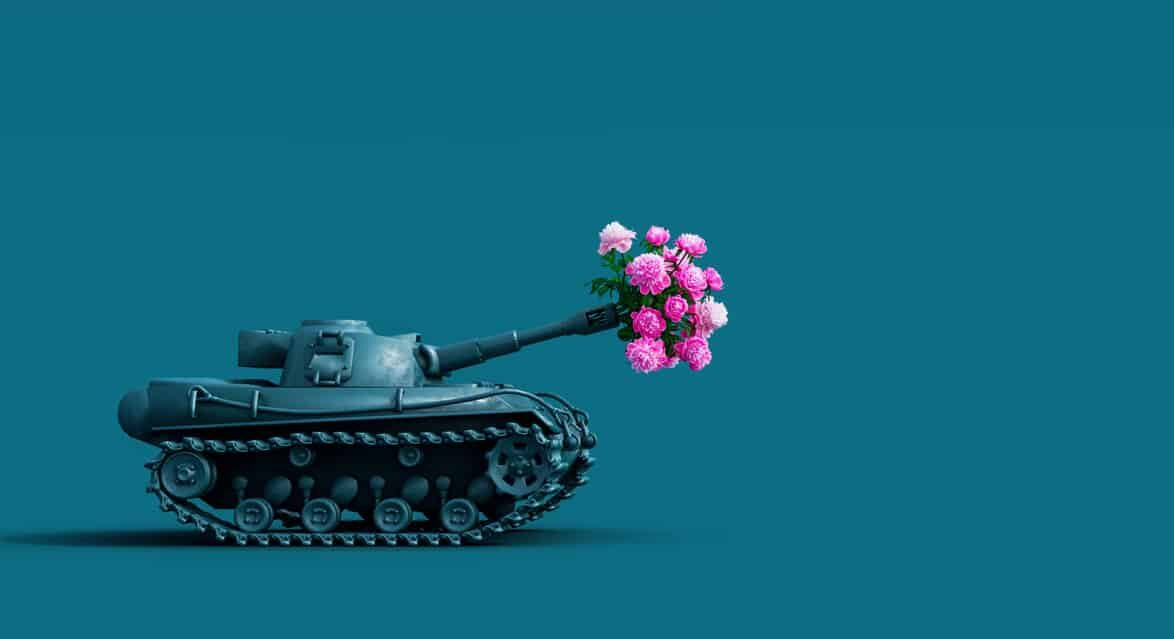
We seem to be forever waging wars. There are, of course, the “real” wars, fought with armed troops and increasingly sophisticated weaponry, wars in which a nation rallies against an enemy who threatens its “vital interests” or its very existence. But even in times of political peace, we are constantly battling the demons which menace our material and moral well-being: we wage wars against crime, against drugs, against disease, against illiteracy. Within, we fight our personal battles, be it a battle against one’s own selfishness or laziness, against an addiction to tobacco or a tendency to overeat.
Nor does it end with the battling of evil and negative forces: in school, in the workplace or in the social arena, we are constantly fighting our way to the top, constantly combating the obstacles in our quest toward greater success. We struggle to get more for our money, to use our time more efficiently, to develop our talents, to improve our mind and refine our character. Intrinsic to our humanness is the unceasing drive to make more of ourselves, to reach beyond yesterday’s attainments. Man is forever at war with the past.
So even when we overcome the blatant evils which inhabit our world, even when we succeed in bringing to light the goodness that is the essential nature of G-d’s creation—will we ever experience peace and tranquillity? Wherever we turn, we encounter turmoil. The solar system spins like a top, the galaxies simmer and revolve. The earth’s core is aboil, its atmosphere storms, its oceans churn. Physical life is sustained by perpetual motion—the throb of the heart, the contraction and expansion of the lungs. Seemingly “inanimate” matter is a cauldron of motion on the nuclear, atomic and sub-atomic levels. Motion means change, and every change is a struggle—the struggle to vanquish the status quo and replace it with a new reality.
The primary culprit in this is the phenomenon of time: time is what gives us a past to abandon, a present to not suffice with, a future towards which to strive. Time is the mother of motion, change, and struggle. Time is the canvas upon which all battles of life are etched. It would seem that as long as we exist in time, as long as our lives are defined by its pulse and flux, the battle of life will rage on.
Can man transcend time? A timeless existence would be free of motion, stress and strife. But would a timeless existence allow for challenge, improvement and progression?
Will it ever end? Should it ever end?
The Creation of Time
Each day has its particular function
Zohar, part III, 94b
Time, our sages tell us, is a created entity. Like all other creations, it was willed into being by the Almighty out of a prior state of nonexistence. In other words, the fact that time did not exist prior to G-d’s creation of the universe was not simply because there were no physical beings or forces, and thus no events to mark the passage of time; rather, it was because the entity “time”—its nature, its substance, its very notion—had not yet been created by G-d.[1]
G-d’s creation of the universe spanned seven days, each of which saw the creation of a new class of elements particular to the intrinsic nature of that day. For these seven days served (and continue to serve) as channels for the seven divine attributes (sefirot) that the Almighty chose to invest in His creation of our reality: the things created on the first day of creation are of a “giving” or “bestowing” nature, corresponding to the divine attribute of chessed that defines that day’s creations; those created on the second day embody “constraint” and “severity,” in keeping with the attribute of gevurah; and so on.
What is true of creation as a whole, is also true of the particular creation called “time.” Time, like the universe it underlies, was created in seven days because it possesses seven distinct qualities—on each day of creation, another dimension of time was brought into being.
In other words, not only is time per se an original creation, but also the divisions and cycles by which it is measured and defined are entities created by the Almighty. The day, week, month and year are not arbitrary measures of time. They are not artificial handles on a basically theoretical reality, invented by man so that he may make appointments or plan his vacation. Rather, they reflect time’s intrinsic texture and character.
Most basic of these is the week. The creation of time over seven days means that time is a seven-hued spectrum: chessed-time was created on the first day, gevurah-time on the second day, and so on. It was not until “G-d concluded, on the seventh day, the works which He had made”[2] that the seven basic components of time were completed and fixed in place as a seven-day cycle.
This explains why, in Hebrew, Sunday is called Yom Rishon, “the first day,” Monday is Yom Sheini, “the second day,” and so on. This is not merely a reference to the first week of time, in which Sunday was the first day ever and Monday the second. Each Sunday is literally a first day, the first of a new time cycle which repeats, from the beginning, the seven qualities of time, which represent the spiritual meaning of days of the week.
The Element of Rest
G-d concluded on the seventh day the works He had made; and He rested on the seventh day from all the works He had made
Genesis 2:2
The above verse appears to contradict itself: did G-d conclude His work on or before the seventh day? Were there six or seven days of creation?
Our sages explain: “What was the world lacking? Rest. When Shabbat came, rest came.”[3] On Shabbat G-d created the element of rest—the final and culminating brick in the edifice of creation.
On the eve of the first Shabbat, the creation of time was also almost complete, lacking only the element of rest. With the creation of Shabbat-time—time possessing the quality of rest—the cycle was closed.
But can “rest” be considered a characteristic of time? Is not time, and its sister-phenomenon, motion, the very antithesis of rest?
But that is precisely the point. Shabbat represents an area in time that transcends time’s own basic definition. Time, though synonymous with motion and change, also includes an element of rest—a potential to create, within the framework of time, an area of permanence and serenity. A potential to bring harmony and tranquillity to the struggles and fluctuations of life.
So while the “weekday” aspect of our lives is defined by Torah as “going out to war on your enemies,”[4] of Shabbat it is said: “Sit, each man in his place; no man shall go out of his place on the day of Shabbat.”[5] If our life’s mission is to “go out,” to vanquish the negative, to perfect the imperfect, to extend oneself beyond the limitations of our presently defined self—it also includes the potential for rest, for settling down, for the peace of finding one’s true “I” and place. Life includes not only the challenge of getting there, but also the fulfillment of being there.
A Taste
On the first Shabbat of history, there was no darkness. The light lasted for 36 hours
Midrash Rabbah, Bereishit 11:2
Shabbat has a profound effect on the entire week. If, in our daily lives, we experience not only the drive for achievement but also satisfaction over what has been achieved; if we have the ability not only to vanquish the prevalent reality but also to transform it into a friend and ally; if our life is not only an ongoing quest but also a series of attainments—it is because Shabbat, an island of rest in a sea of flux, radiates of its essence to the other six components of time.
But if every day of our week has something of Shabbat in it, on Shabbat itself we enter into a dimension in time whose essence is rest and tranquillity. “Six days a week you shall labor,” commands the Torah, “and you shall do all your work; the seventh day is Shabbat to G-d…”[6] But how can we tell a person to do “all your work” in six days? Even to conclude “all your work” in the course of one’s lifetime is no small feat! But on Shabbat, explain our sages, “all your work” is indeed “done.”[7] Shabbat is not only a break in the toil of life, but a glimpse and a taste of its ultimate realization.
On Shabbat, we cease to struggle with the world not because the task of perfecting it is “on hold,” but because on Shabbat, the world is perfect: we are relating to that which is perfect and unchanging in it. We cease to battle darkness not merely to recoup our strength for the next onslaught, but because there is no darkness—the light which we have created through our positive deeds, obscured throughout the week by the veil of mundanity which shrouds our workday lives, is now perceptible to our more rarefied selves.
This better explains why each Sunday is indeed a “first day.” Shabbat is a venture into the realm of timelessness—a realm that lies beyond the struggles that characterize our weekday lives. Following each Shabbat, we return to a time-bound existence. Time, in the sense of motion and flux, begins anew.
Shabbat, however, is but a foretaste of “the day that is wholly Shabbat and rest, for everlasting life.”[8] The seven-day week is a microcosm of a far greater time-span: the entirety of history is also a “week,” comprised of six “workday” millennia and a seventh millennium of rest, the era of Moshiach.[9]
On the weekly Shabbat, we experience the perfection that has been achieved through our efforts of the past six days to develop and refine our world; the era of Moshiach is the time when the combined attainments of all generations of history will be realized. A time when every positive deed, word and thought of the six millennia of the human experience will result in a truly tranquil world—a world free of discord and strife, a world suffused with the wisdom, goodness and perfection of its Creator.
The Reversal of Time
Students of Torah have no rest, not in this world and not in the world to come, as it is written: “They go from strength to strength, beheld by G-d in Zion”[10]
Talmud, Berachot 64a
Yet Shabbat is an integral part of time. Even the messianic age is an era within time—a seventh millennium of history. Obviously, these are also arenas for progression and achievement. For were they to represent wholly static states of being, why would we regard them as epochs in time?
On the most basic level we might explain that, indeed, both the work-week and Shabbat, both the six millennia of history and the era of Moshiach, are times for advancement and progression. The difference lies in the manner in which this is achieved. Our “work-week” challenges include dealing with outright evil and negativity, so progress inevitably involves struggle. On Shabbat, however, and to an even greater extent, in the age of Moshiach, advancement and progression means the tranquil graduation from good to better, the attainment of greater heights within the infinite realm of good itself.
If today we fight to eliminate war and hatred, in the era of Moshiach, when “they shall beat their swords into plowshares,”[11] the pursuit of peace will mean finding deeper and more meaningful ways for people to unite and fuse their differences into a symphonious whole. If today we must struggle to defeat illness, the “medicine” of the seventh millennium will concern itself with the further perfection of already flawless health and the enhancement of the bond between body and soul. If today we must battle ignorance, in the era when “the world shall be filled with the knowledge of G-d as the waters cover the sea,”[12] the quest for wisdom will be for greater and greater degrees of insight into the infinite truth of all truths.
Nevertheless, this does not fully answer the question. For any change, any departure from a previous state, is ultimately a battle and struggle, albeit a far more subtle battle and struggle than the conquest of evil. Again we ask: how can any form of progress be defined as a state of rest?
But progress may have two directions: outward and inward. The equation of progress with struggle, of graduation with change, is valid if we speak of “going out of our place,” of reaching beyond what we are to make more of ourselves. But there is also a progress that is an inward journey, a journey to uncover deeper dimensions to our own being.
In such an inward journey, each successive station is not a “change,” but the very opposite of change: it is a state that is more consistent with who and what we truly are. It is “rest” in the truest sense of the word: a settling into one’s true “place” and identity.
“G-d created man in His image,”[13] creating him to reflect His own goodness and perfection. In the “workday” phases of our existence, the mantle of corporeality which shrouds our world and encases our souls causes us to lead lives that are at odds with our true identity and essence. So the betterment of ourselves and our world is a struggle, a battle to change reality (or rather, what to our perception is reality) into something which is (again, to our perception) beyond us. But in truth, this “reality” is a distortion of our true selves, while the elusive “beyond” is our true self.
So when six millennia of struggle and achievement will come to fruition, when six millennia of battling darkness will reveal the light within, we will experience an era “that is wholly Shabbat and rest.” This is not a golden age of retirement for humanity, for the potential within us is as infinite as the divine perfection it reflects. But the direction of “progress” will be reversed: from a conflict-ridden, outward-bound quest for change, to a serene, inward-bound encounter with self.
But this “reversal” of the flow of time is not confined to the seventh millennium. Every Shabbat is a taste of this futuristic time, and a provider of its tranquillity to the entire week. While yet in the midst of the war of life, we are enabled to experience moments of true “rest.” Even as we struggle to transcend the imperfections of a more external self, we can touch base with the goodness and perfection that lies at the core of each and every one of us.
Based on the Rebbe’s talks on various occasions[14].
_______________________________
[1]. Rabbi DovBer of Mezeritch, quoted in Siddur Im D’ach, Shaar HaKriat Shema, 75d ff.
[2]. Genesis 2:2.
[3]. Rashi on verse.
[4]. Deuteronomy 21:10; Likkutei Torah, Teitzei 35c; et al.
[5]. Exodus 16:29.
[6]. Ibid., 20:9-10.
[7]. Mechilta on verse.
[8]. Grace After Meals, addendum for Shabbat.
[9]. Nachmanides’ commentary on Genesis 2:3.
[10]. Psalms 84:8.
[11]. Isaiah 2:4.
[12]. Ibid., 11:9.
[13]. Genesis 1:26.
[14]. Likkutei Sichot, vol. XVII, pp. 59-61; Sefer HaSichot 5752, vol. II, pp. 502-514.





This was especially for me. Thank you.